Here's a truth that changes everything about PTE Reading preparation: the Reading section isn't just about reading. Almost half of your Reading score is determined by tasks that don't even appear in the Reading part of the exam. Once you understand how PTE's integrated scoring system works, you can stop wasting time on low-value tasks and focus your energy where it actually moves your score.
This guide breaks down the exact score contributions, strategies, and time management techniques that top scorers use to hit 79+ and 90 in the Reading section. Every piece of advice here is based on verified PTE scoring data and proven test-taking methods.
If you haven't read it yet, start with our PTE Academic 2026 Complete Guide for an overview of the entire exam structure and scoring system.
Quick Summary (click to expand)
- 39% of your Reading score is locked in before the Reading section even starts
- Fill in the Blanks (both types) = 45% of your Reading score
- FIB strategy: read 2-3 words around the blank, use grammar clues aggressively
- Reorder Paragraphs: find first sentence + linked pairs, apply the 90-second rule
- MCQ is a time trap — spend max 60-90 seconds, don't guess on negative-marking MCQs
- The "2 out of 3" rule: be excellent at 2 core groups for 79+
- Time management: 60% on FIBs, sacrifice MCQs if running low
- Build collocations, practice SWT and HIW as priority cross-section tasks
The Secret Most Students Miss: Your Reading Score Starts Outside the Reading Section
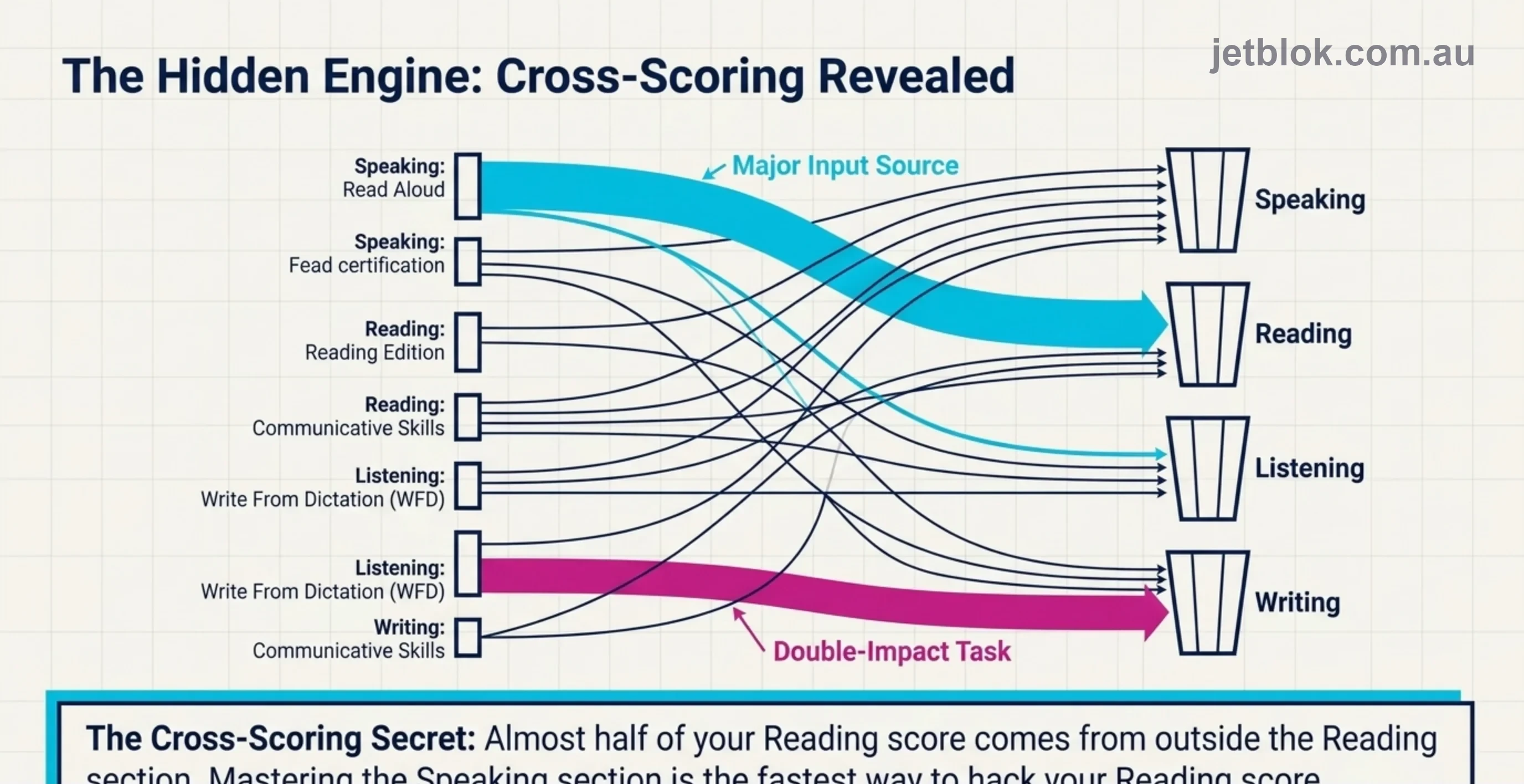
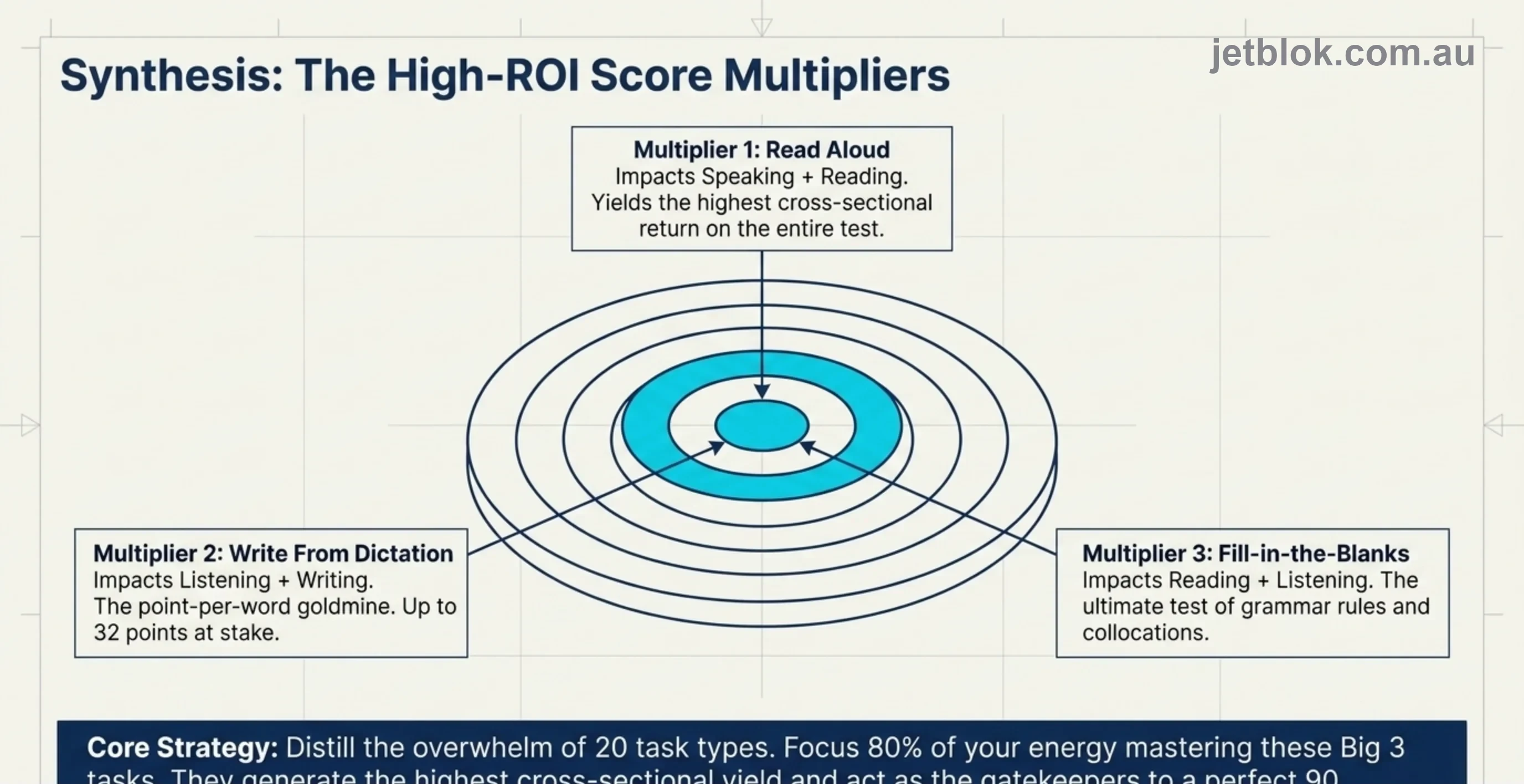
This is the single most important insight for PTE Reading preparation, and most students have no idea it exists. Because PTE uses an integrated scoring model, several tasks from the Speaking & Writing and Listening sections feed directly into your Reading score.
Here's the breakdown of how much of your Reading score comes from outside the Reading section:
- Summarize Written Text (SWT) — contributes 23% of your Reading score
- Highlight Incorrect Words (HIW) — contributes 13% of your Reading score
- Highlight Correct Summary (HCS) — contributes 3% of your Reading score
That means roughly 39% of your Reading score is already locked in before you even open the Reading section. If you bomb Summarize Written Text or Highlight Incorrect Words, your Reading score will suffer no matter how well you perform on the actual Reading tasks.
Key Takeaway: PTE Reading preparation doesn't start with the Reading section. It starts with mastering SWT in Writing and HIW in Listening. If you're scoring below your target in Reading, check your SWT and HIW performance first.
Official Reading Score Breakdown: Where Every Point Comes From
Now let's look at the tasks that actually sit inside the Reading section and exactly how much each one contributes to your score. These numbers come from verified PTE scoring data:
| Task | Overall Score Contribution | Reading Score Contribution |
|---|---|---|
| FIB Dropdown (R&W) | 7% | 25% |
| FIB Drag & Drop (Reading) | 6% | 20% |
| Reorder Paragraphs | 3% | 9% |
| MCQ Multiple Answer | 1% | 5% |
| MCQ Single Answer | <1% | 3% |
Look at those numbers carefully. The two Fill in the Blanks task types combined account for 45% of your entire Reading score. That's nearly half your Reading result from just two task types. Meanwhile, MCQ Single Answer contributes less than 1% to your overall score and only 3% to Reading.
This tells you exactly where to invest your preparation time and, just as importantly, where to stop wasting it.
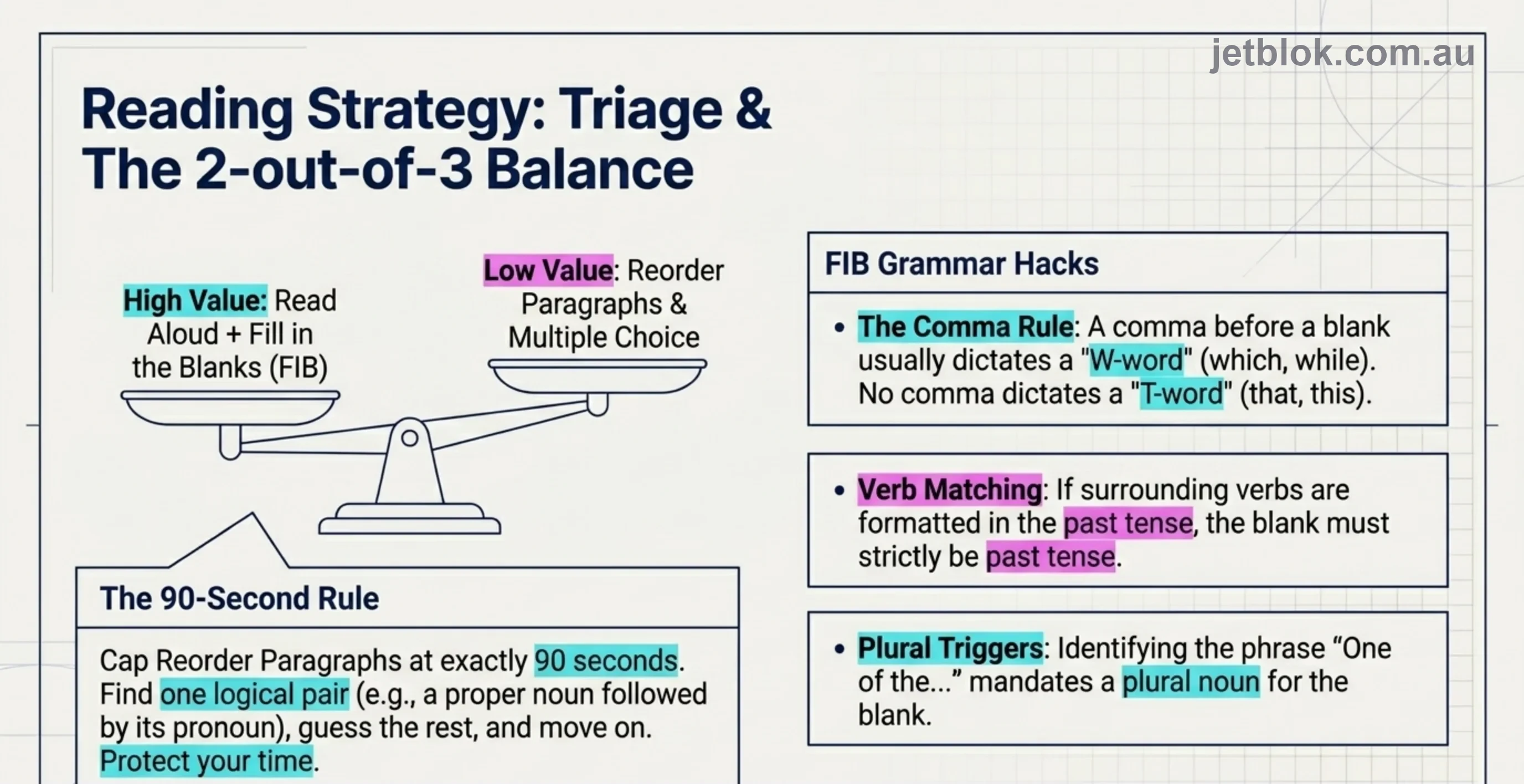
Fill in the Blanks: The Core Strategy (45% of Your Reading Score)
Since Fill in the Blanks tasks account for 45% of your Reading score, let's break them down in detail. There are two types, and each requires a slightly different approach.
FIB Dropdown — 25% of Reading
In this task, you read a passage with blanks and select the correct word from a dropdown menu for each blank. This is the single highest-contributing task in the Reading section.
Strategy:
- Read 2-3 words before and after the blank. The answer almost always connects logically to the immediate surrounding context. Don't read the entire paragraph before answering — the clues are local, not global.
- Read for logic, not synonyms. Students often look for the word that "means the same" as something in the passage. Instead, ask yourself: "Which word makes this sentence make sense?" The correct answer completes the logical flow of the sentence.
- Use grammar clues aggressively. Pay attention to prepositions that follow the blank, verb tenses used in the same sentence, and articles (a/an/the) that precede the blank. These grammar signals eliminate wrong answers faster than trying to understand the full meaning.
Example: If you see "The study was _____ by a team of researchers," the blank needs a past participle (conducted, performed, led). The preposition "by" tells you this is a passive construction, immediately eliminating any active verb options.
FIB Drag & Drop — 20% of Reading
In this task, you drag words from a word bank into blanks within a passage. You'll typically have more words than blanks, so not every word gets used.
Strategy:
- Solve the EASY blanks first. This is the most important technique for drag-and-drop. When you confidently place a word in an easy blank, you physically remove it from the available options, making harder blanks easier by reducing choices.
- Eliminate, don't guess. For each blank, go through the word bank and actively cross off words that are grammatically impossible or semantically absurd. "This can't be a noun because the blank needs a verb" — that kind of elimination is faster and more accurate than trying to pick the "best" answer.
- Use the 50/50 strategy for tough blanks. If you can eliminate all but two options, you have a 50% chance of getting it right. That's far better than random guessing from a pool of 6-8 words. And remember — FIB tasks award partial credit. Every correct word counts.
Grammar Rules for FIBs: Your Cheat Sheet
These specific grammar patterns appear repeatedly in PTE Fill in the Blanks. Memorize them and you'll solve blanks faster and more accurately:
Verb Tense Matching: Look at other verbs in the same sentence or clause. If the sentence says "The researchers discovered that the compound _____ significant results," the blank needs a past tense verb (produced, showed, yielded) to match "discovered."
Singular/Plural Agreement:
- "One of the _____" → always followed by a plural noun (one of the reasons, one of the factors)
- "Another _____" → always followed by a singular noun (another reason, another study)
- "Each _____" → singular noun (each participant)
- "Several _____" → plural noun (several studies)
The Comma Rule: This is a powerful shortcut that most students don't know:
- Comma before the blank → the word is likely which or while (non-restrictive clause)
- No comma before the blank → the word is likely that or this (restrictive/defining clause)
Academic Vocabulary Bias: PTE passages are drawn from academic texts. When you're torn between two options that seem equally correct, choose the more formal, academic, or extreme word. In academic English:
- Furious is preferred over upset
- Tremendous is preferred over huge
- Substantial is preferred over big
- Detrimental is preferred over bad
Common Collocations: Academic English uses fixed word pairings. Knowing these lets you fill blanks instantly:
- depend ON / rely ON
- struck BY / affected BY
- involved IN / engaged IN
- vibrant colours (not bright colours in academic text)
- conduct research / carry out an experiment
- pose a threat / raise a concern
Reorder Paragraphs: 9% of Reading Score
Reorder Paragraphs can feel overwhelming — you're staring at 4-5 jumbled text boxes and need to put them in logical order. But with the right method, you can consistently get 2 out of 4 pairs correct, which is enough for a strong score on this task.
Step 1: Find the First Sentence
The first sentence in any paragraph sequence has very specific characteristics. It does NOT contain:
- Pronouns without antecedents: Words like it, they, them, these refer to something mentioned earlier — so the sentence can't be first
- Contrast/transition words: Words like but, however, nevertheless, on the other hand contrast with a previous idea — so something must come before
- Reference words: Words like these findings, that approach, such methods refer back to previously mentioned concepts
The first sentence typically introduces a topic, person, place, or concept using its full name or a general statement.
Step 2: Find Linked Pairs
Instead of trying to order all 5 sentences at once, look for pairs that clearly connect:
- Noun → Pronoun connections: If sentence A says "Dr. Smith conducted a study" and sentence B says "She found that...", B must follow A
- Contrast pairs: If sentence A presents one viewpoint and sentence B starts with "However," or "On the other hand," B follows A
- Cause → Effect pairs: "X happened" followed by "As a result..." or "Consequently..."
- General → Specific pairs: A broad claim followed by a sentence with specific evidence or examples
Step 3: Use Chronological and Logical Markers
For time-based or process texts, chronological markers reveal the order: initially, first, then, subsequently, finally.
There's also a useful pattern: the words "so," "but," and "now" almost always appear in that specific order when they show up in a reorder task.
The "2 out of 4" Rule
Here's the good news: Reorder Paragraphs uses partial credit scoring based on correct pairs. If there are 5 sentences, there are 4 adjacent pairs to get right. Getting 2 out of 4 correct pairs is typically enough to support a 79+ Reading score from this task alone. You don't need perfection.
The 1-Minute Rule
Never spend more than 2 to 2.5 minutes on a single Reorder Paragraphs question. This task contributes only 9% of your Reading score. If you're stuck after identifying 1-2 clear pairs, make your best arrangement and move on. Your time is far more valuable on Fill in the Blanks tasks.
MCQ Strategy: The Time Traps You Must Avoid
Multiple Choice Questions are the biggest time traps in the PTE Reading section. Students spend 5-7 minutes agonizing over MCQs that contribute almost nothing to their score. Stop doing this.
MCQ Single Answer — Less Than 1% of Overall Score, 3% of Reading
This task contributes so little to your score that the optimal strategy is almost comically simple:
- Read the question stem quickly
- Scan the passage for the relevant section
- Select the answer that seems most likely
- Move on immediately
There is no partial credit — it's correct or incorrect. Don't overthink it. Spending 4 minutes instead of 60 seconds gains you almost nothing but costs you time you need for FIBs.
MCQ Multiple Answer — 1% of Overall Score, 5% of Reading
This task is actually dangerous because it uses negative marking. Every wrong selection deducts points from your score. Guessing can result in a negative score for the question.
The safest strategy: Select exactly one answer you're most confident about and move on immediately. By choosing only one answer, you eliminate the risk of negative marking while still picking up a point. The potential gain from selecting additional correct answers is not worth the risk of selecting a wrong one and losing points.
Time Rule: Spend no more than 60-90 seconds on any MCQ question. If you haven't decided by then, select your best guess and move forward. Protecting your time for FIBs is worth more than any possible MCQ points.
The "2 out of 3" Rule for Scoring 79+
You don't need to be perfect at everything in the Reading section. The math works in your favour if you understand the score distribution. To hit 79+ in Reading, you need to be excellent at 2 out of these 3 core groups:
- Fill in the Blanks (both types) — 45% of Reading score
- Reorder Paragraphs — 9% of Reading score
- Cross-section contributors (SWT + HIW) — 36% of Reading score
If you're strong in FIBs and your SWT/HIW performance is solid, you can afford to be mediocre at Reorder Paragraphs and still hit 79+. If your FIBs are strong and Reorder is strong, you have more buffer for SWT errors. The point is: you don't need to master every single task. Focus your energy on the combination that plays to your strengths.
Understanding Scoring Types: Why It Matters for Strategy
Different Reading tasks use different scoring mechanisms, and understanding these changes how you should approach each one:
| Task | Scoring Type | What It Means for You |
|---|---|---|
| FIB (Both Types) | Partial Credit | Every correct word earns points — never leave a blank empty |
| MCQ Multiple | Negative Marking | Wrong selections deduct points — be conservative, select fewer answers |
| MCQ Single | Correct/Incorrect | No partial credit — guess confidently and move on |
| Reorder Paragraphs | Partial Credit (Pairs) | Each correct adjacent pair scores independently — even 2 correct pairs earn significant points |
The key insight: partial credit tasks reward attempt. For FIBs, fill in every single blank even if you're unsure — a 30% chance of being right is better than 0%. For MCQ Multiple, the opposite is true — restraint protects your score.
Time Management Plan: Your Reading Section Blueprint
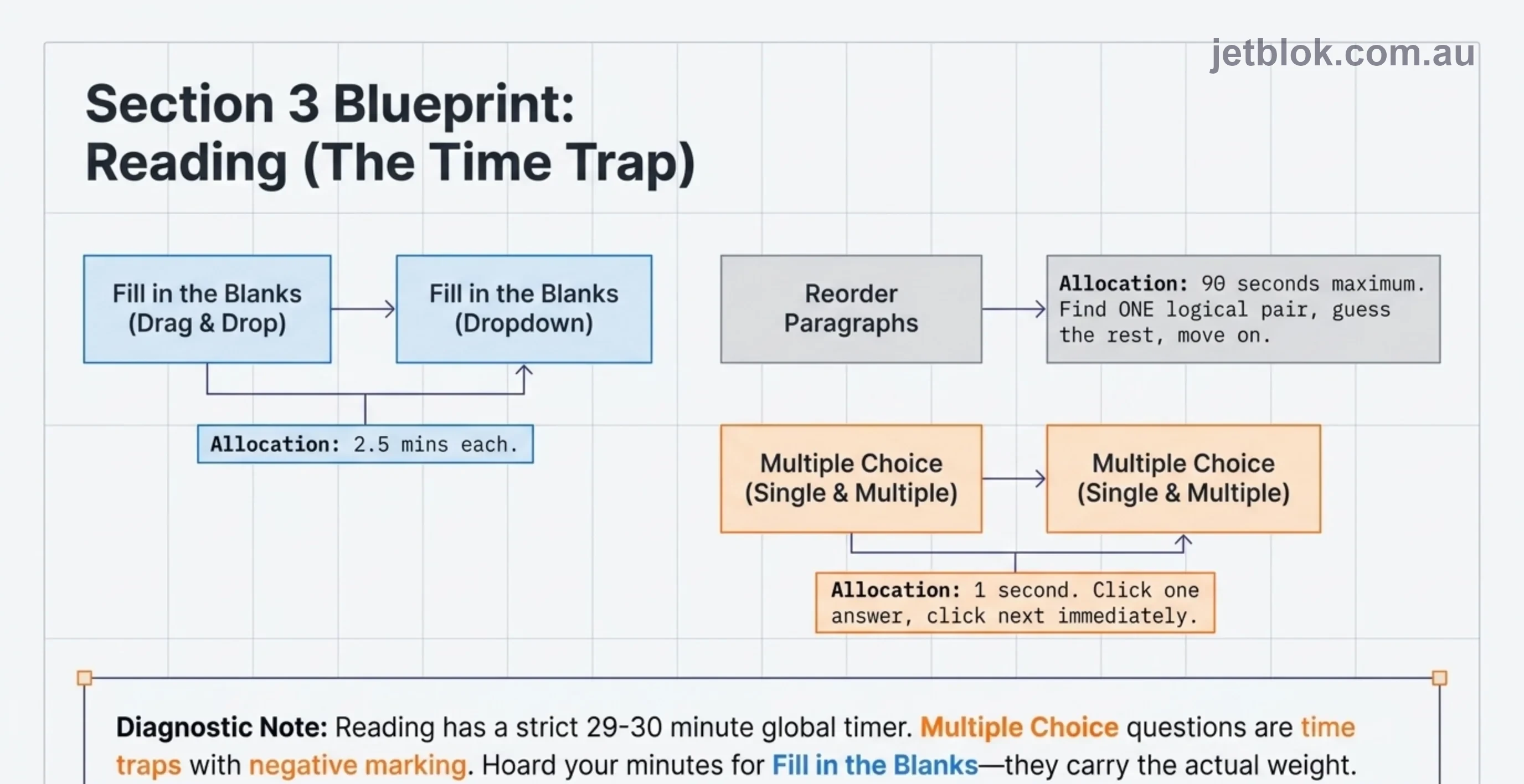
Time management is the difference between students who know the material and students who actually score well. The Reading section gives you approximately 29-30 minutes. Here's exactly how to allocate it:
| Task Type | Time Allocation | Priority |
|---|---|---|
| R&W Fill in the Blanks (Dropdown) | 2.5–3 minutes per question | HIGHEST — 25% of Reading |
| Reading Fill in the Blanks (Drag & Drop) | 2–2.5 minutes per question | HIGH — 20% of Reading |
| Reorder Paragraphs | 2–2.5 minutes per question | MEDIUM — 9% of Reading |
| MCQ Multiple Answer | 60–90 seconds MAX | LOW — 5% of Reading |
| MCQ Single Answer | Whatever time remains | LOWEST — 3% of Reading |
The golden rule: If you're running low on time, sacrifice MCQ tasks without hesitation. Guessing on MCQ Single costs you almost nothing (3% of Reading). Running out of time on an FIB costs you a massive chunk of your score.
Pro Tip: Be Alert After Essay Writing
Here's a trap that catches even well-prepared students: the Reading section timer starts immediately after the Writing section ends. There's no break, no transition screen that pauses the clock. Many students lose 3-4 minutes because they're mentally still in "essay mode" and read the instructions too slowly or take too long to orient themselves.
When your essay is done, snap into Reading mode immediately. You already know what the tasks look like — you don't need to read every instruction word by word. Those 3-4 saved minutes can mean one more FIB answered correctly, which could be the difference between 78 and 80.
Building Your FIB Practice Routine
Since Fill in the Blanks is worth 45% of your Reading score, your practice routine should reflect that weight. Here's a structured approach:
Week 1-2: Build Your Collocation Bank
Academic English runs on fixed word pairings. Spend two weeks actively building a personal collocation list:
- Read academic passages and highlight word combinations that feel natural together
- Note preposition patterns: contribute TO, result IN, lead TO, account FOR
- Learn adjective-noun pairs: significant impact, substantial evidence, fundamental principle
- Practice with PTE-specific platforms like APEUni that use AI scoring calibrated to Pearson's system
Week 3-4: Speed and Accuracy Drills
Now focus on solving FIBs under timed conditions:
- Set a timer for 2.5 minutes per question — no extensions
- Practice the "context window" technique: read only 2-3 words before and after each blank
- After each practice set, review your errors and categorize them: was it a vocabulary gap, a grammar mistake, or a collocation you didn't know?
- Track your accuracy percentage — aim for 70%+ on Dropdown and 65%+ on Drag & Drop
Week 5+: Full Section Simulations
Practice entire Reading sections under real exam conditions:
- Use a strict 29-minute timer
- Follow the time allocation plan exactly
- Practice the mental switch from Writing to Reading (do a practice essay first, then immediately start the Reading section)
- Review not just your answers but your time distribution — did you spend too long on MCQs?
Common Mistakes That Kill Reading Scores
After working with hundreds of PTE students, these are the patterns we see most often in students who underperform in Reading:
Mistake 1: Spending Equal Time on All Tasks
If you spend 3 minutes on MCQ Single and 2 minutes on FIB Dropdown, you've got your priorities backwards. MCQ Single is worth 3% of Reading; FIB Dropdown is worth 25%. Your time allocation should match these numbers.
Mistake 2: Reading the Entire Passage Before Answering FIBs
You don't need to understand the whole passage to fill in blanks. The context clues are local — within 2-3 words of the blank. Reading the full passage first wastes 30-60 seconds per question that you can't afford.
Mistake 3: Selecting Multiple Answers in MCQ Multiple
Negative marking means every wrong answer deducts from your score. Selecting 3 answers when you're only sure about 1 is a losing strategy. Select the one you're most confident about and move on. The math favours conservatism here.
Mistake 4: Ignoring SWT and HIW Preparation
Students who focus exclusively on Reading-section tasks and ignore Summarize Written Text and Highlight Incorrect Words are leaving 36% of their Reading score to chance. These cross-section contributors need dedicated practice.
Mistake 5: Perfectionism on Reorder Paragraphs
Getting stuck on Reorder Paragraphs for 5+ minutes is one of the most common time management failures. Remember: 2 correct pairs out of 4 is a strong result. Find your pairs, arrange your best guess, and move on.
Putting It All Together: Your Score 90 Action Plan
If you're aiming for 90 in PTE Reading, here's your priority order:
- Master Fill in the Blanks (both types). This is 45% of your Reading score. Practice collocations, grammar rules, and the elimination technique daily. Aim for 80%+ accuracy.
- Nail Summarize Written Text. This task sits in the Writing section but contributes 23% to your Reading score. Write one-sentence summaries of 35-55 words using complex sentence structures.
- Practice Highlight Incorrect Words. This Listening task contributes 13% to Reading. Train your ear to catch words that don't match the text. Be conservative — only highlight words you're certain are wrong.
- Develop a Reorder Paragraphs system. Learn to identify first sentences and linked pairs. Accept "good enough" (2 out of 4 pairs) and protect your time.
- Deprioritize MCQs. Practice them occasionally, but never at the expense of FIB or SWT preparation. On test day, use them as time buffers — rush through them to bank time for FIBs.
The students who score 90 in PTE Reading aren't necessarily better readers than those scoring 70. They're better strategists. They know where the points are, they manage their time ruthlessly, and they don't get trapped by low-value tasks that feel important but contribute almost nothing to their score.
Start your preparation today. Review our Complete PTE 2026 Guide for the full exam overview, then come back here to build your Reading strategy from the ground up.