The PTE Academic exam has changed dramatically since August 2025 — and most guides online are still teaching the old format. If you're preparing in 2026, you need to understand the new 22-question-type structure, the hybrid AI-human scoring model, the official score weightings that reveal exactly which tasks matter most, and the Australian visa thresholds that trip up thousands of applicants every year. This is the definitive guide. We've verified every data point against official Pearson documentation, government migration policy, and top coaching sources so you don't have to.
Quick Summary (click to expand)
- PTE Academic is a 2h15m computer-based English test with AI + human scoring
- 22 question types across 3 parts, including 2 new tasks added in August 2025
- Hybrid AI + human scoring — templates are now penalized
- Your Overall Score is NOT the average of your four skills
- 6 tasks account for 52% of your overall score — Describe Image alone is 15%
- SGD and RTS are new high-impact tasks since August 2025
- PTE Speaking needs 76+ for IELTS 7.0 equivalent — much higher than expected
- Australian visa: Writing requires the largest jump for Superior English (+16 points)
- Flow over perfection — the AI prioritizes fluency over accuracy
- 90-day study plan organized by official score weightings
What is PTE Academic?
PTE Academic (Pearson Test of English Academic) is a computer-based English proficiency test accepted by thousands of institutions and governments worldwide, including Australia, New Zealand, Canada, the UK, and the USA. It tests Speaking, Writing, Reading, and Listening in a single 2-hour-15-minute session at a Pearson test center. Results are typically available within 48 hours — sometimes within 24 — making it dramatically faster than IELTS.
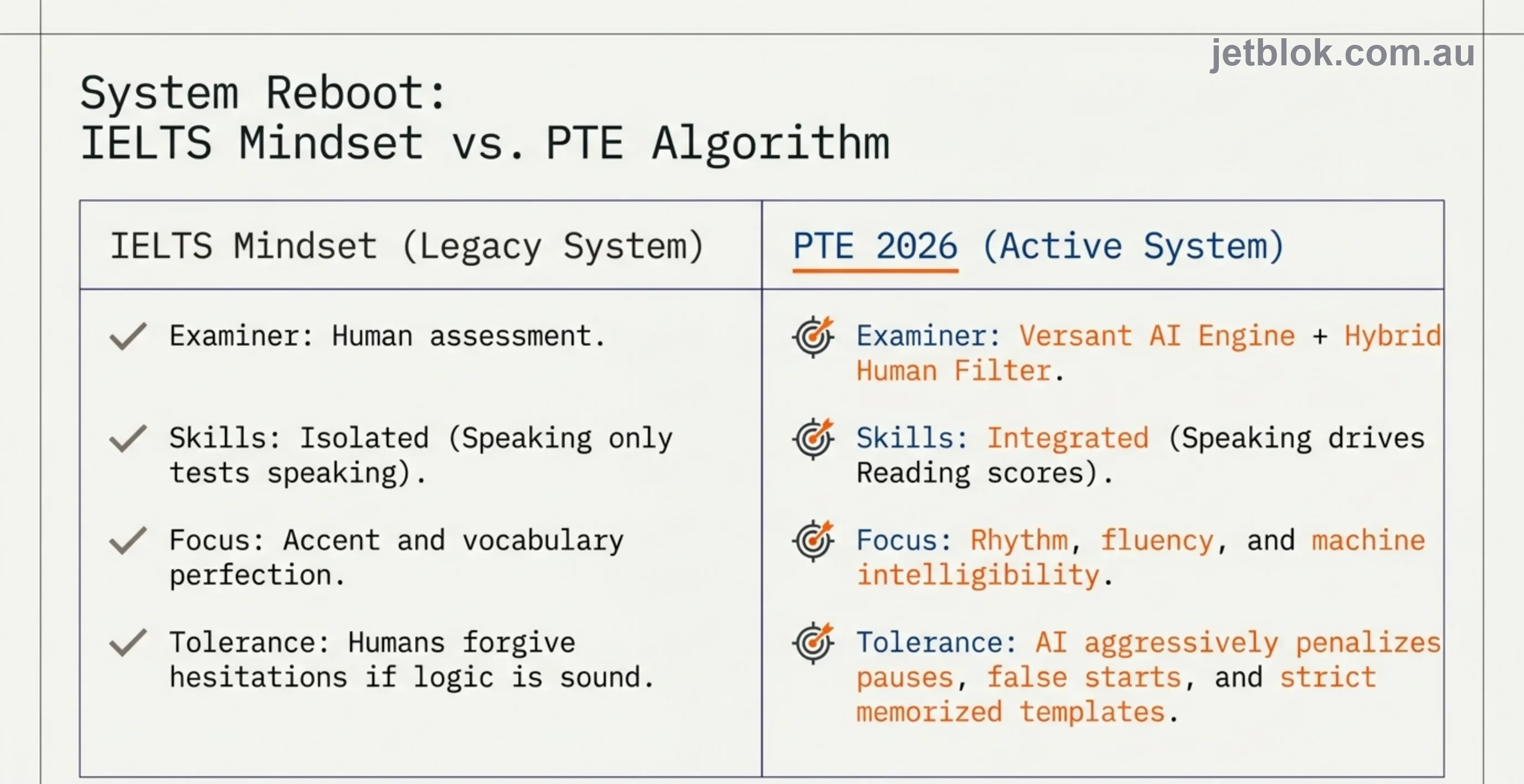
What sets PTE apart is its AI-first scoring engine. Every response is evaluated by Pearson's proprietary algorithms for pronunciation, fluency, grammar, vocabulary, and spelling. In 2026, Pearson added a human review layer for content-dependent tasks, creating a hybrid system that is both more consistent than fully human-graded exams and harder to game with memorized templates.
2026 PTE Test Structure: 3 Parts, 22 Question Types
The 2026 PTE Academic runs approximately 2 hours and 15 minutes (135 minutes) and is divided into three parts with a total of 22 question types — up from 20 before August 2025. Two entirely new tasks were introduced: Summarize Group Discussion and Respond to a Situation.
| Section | Duration | Question Types | Task Types |
|---|---|---|---|
| Part 1: Speaking & Writing | 76–84 minutes | 9 task types (incl. 2 NEW) | Personal Introduction, Read Aloud, Repeat Sentence, Describe Image, Respond to a Situation (NEW), Retell Lecture, Summarize Group Discussion (NEW), Summarize Written Text, Write Essay |
| Part 2: Reading | 23–30 minutes | 5 task types | MCQ Multiple Answers, MCQ Single Answer, Reorder Paragraphs, FIB Dropdown, FIB Drag & Drop |
| Part 3: Listening | 29–36 minutes | 8 task types | Summarize Spoken Text, MCQ Multiple Answers, MCQ Single Answer, FIB Listening, Highlight Correct Summary, Select Missing Word, Highlight Incorrect Words, Write from Dictation |
There is no separate break between sections — the test flows continuously. However, you'll see a short optional break prompt between Part 1 and Part 2. Use it. Even 30 seconds to close your eyes and reset can prevent cognitive fatigue in the Reading section.
The 2026 Scoring System: Hybrid AI + Human
This is the most misunderstood aspect of PTE. The 2026 exam uses a dual-layer scoring system that combines AI precision with human judgment:
How AI Scoring Works
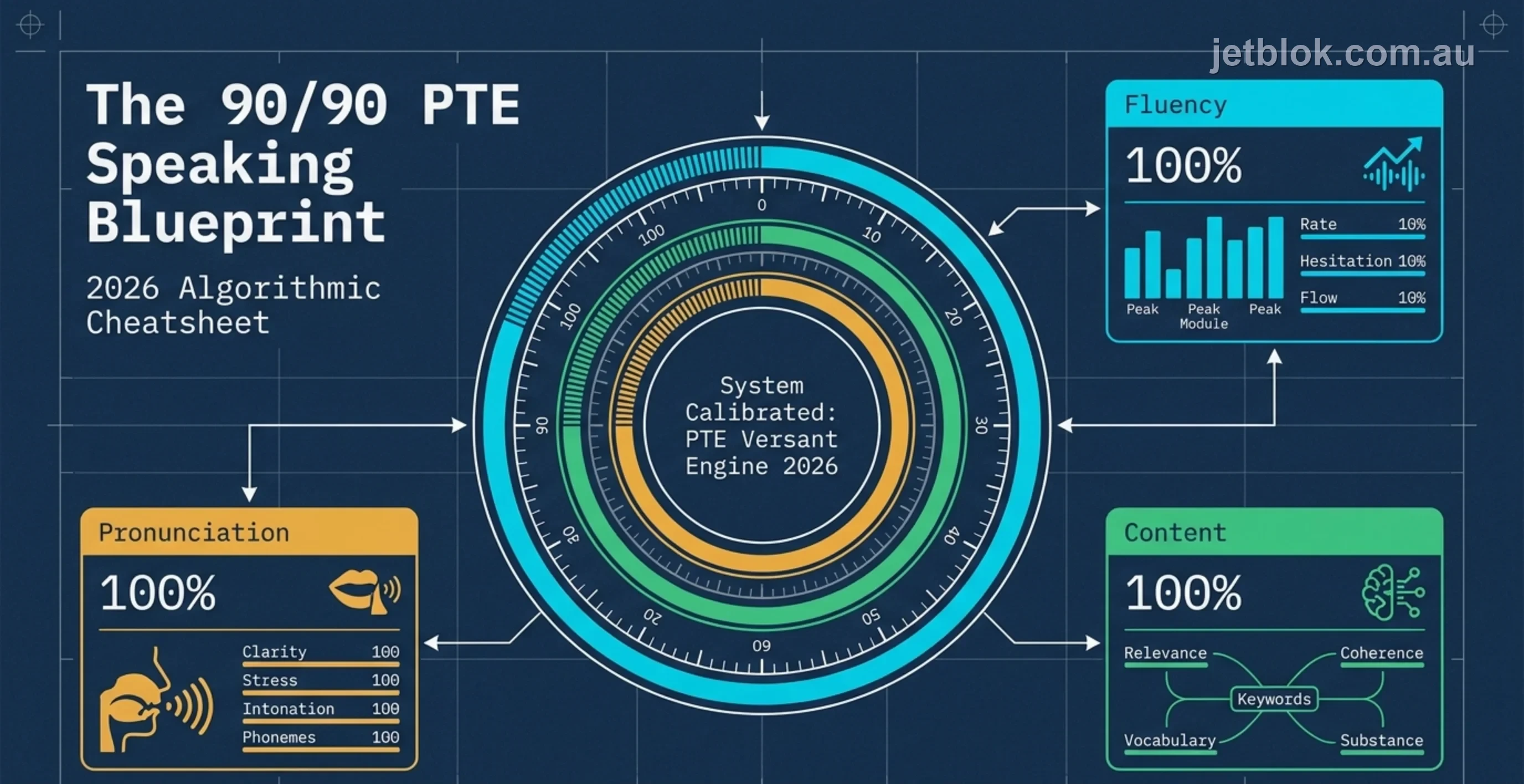
Pearson's AI engine scores every single response across four automated dimensions:
- Pronunciation — phoneme accuracy, word stress, sentence-level intonation
- Oral Fluency — speech rate, rhythm, hesitation patterns, filler detection
- Grammar — clause structure, tense consistency, subject-verb agreement
- Spelling — exact-match checking on typed responses
How Human Scoring Works
Seven specific tasks receive additional human review for content quality:
- Describe Image (DI)
- Retell Lecture (RL)
- Summarize Written Text (SWT)
- Write Essay (WE)
- Summarize Spoken Text (SST)
- Summarize Group Discussion (SGD)
- Respond to a Situation (RTS)
The process works like this: the AI generates a content score, a trained human scorer independently evaluates the same response, and if the two scores differ beyond a threshold, a second human scorer makes the final decision. Critically, humans never judge pronunciation or accent — that remains 100% AI-evaluated, which means your accent genuinely doesn't matter as long as you're intelligible.
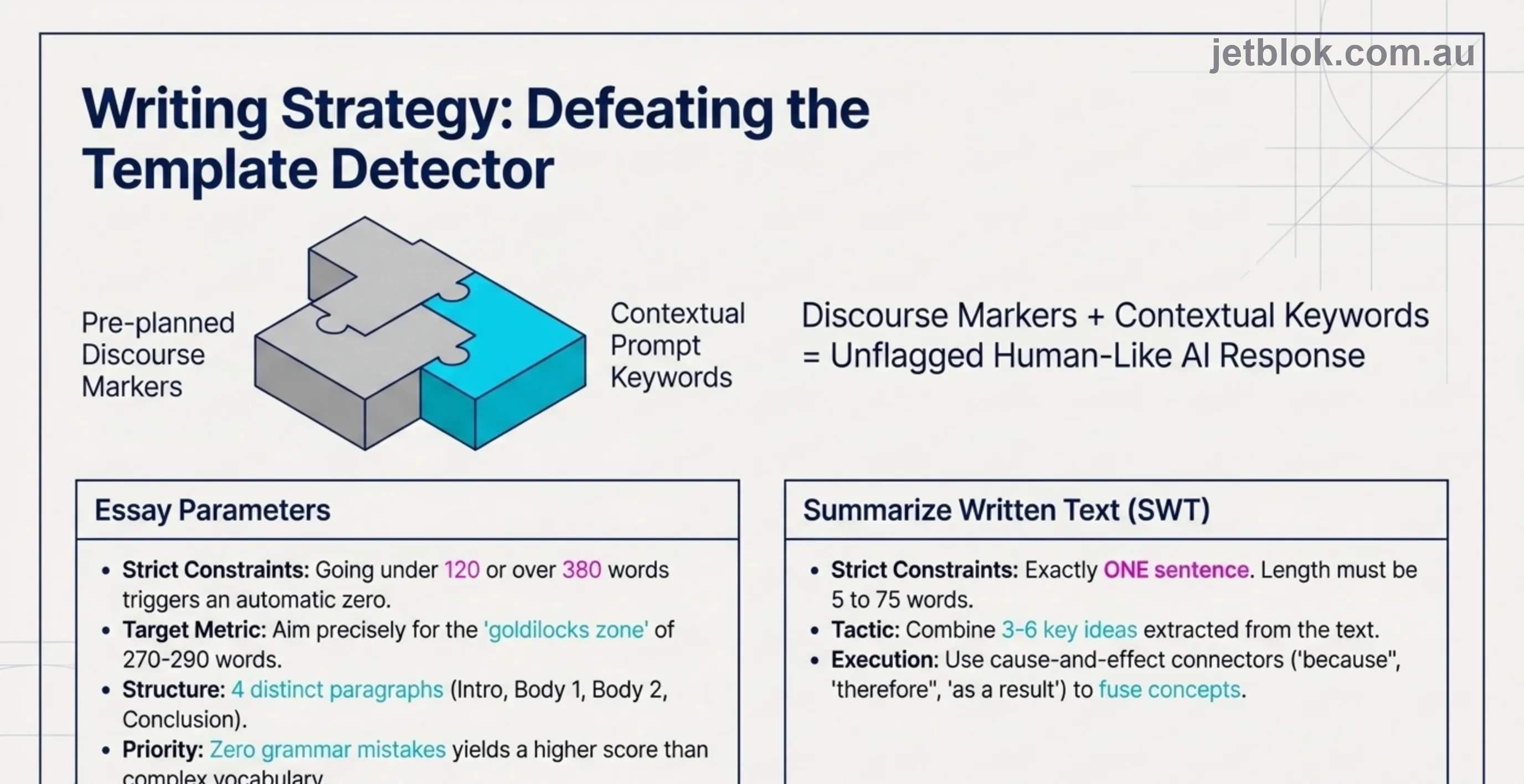
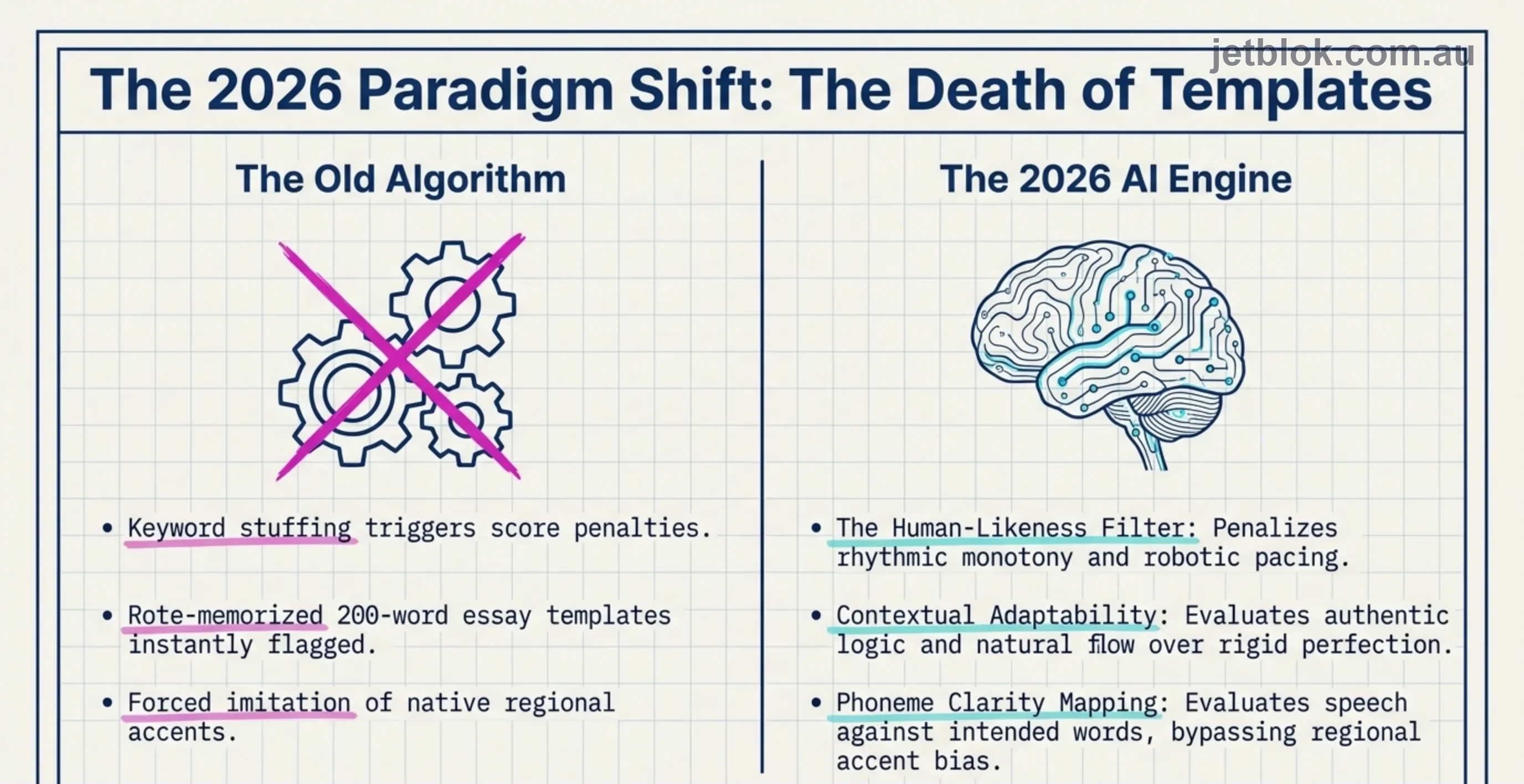
Template Detection Alert: Pearson's algorithms now flag what they call "rhythmic monotony" — responses that follow identical syntactic patterns across thousands of test-takers. Widely-shared rigid templates are being actively penalized. Use flexible frameworks, not word-for-word scripts.
Your Overall Score is NOT the Average of Your Four Skills
This is perhaps the single most important insight in this entire guide. Most test-takers assume their Overall Score equals (Speaking + Writing + Reading + Listening) ÷ 4. It does not.
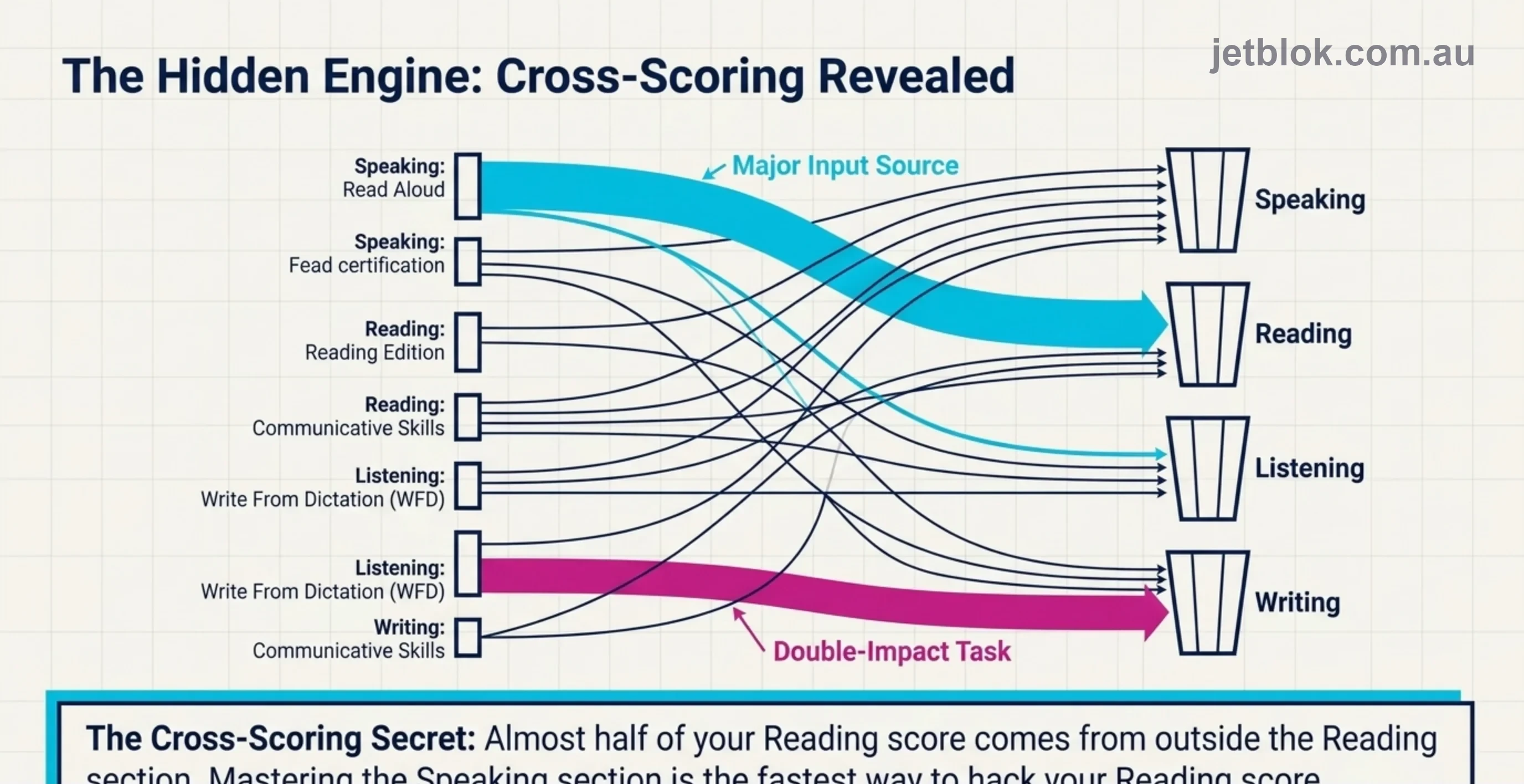
Pearson calculates the Overall Score independently using its own weighted formula that draws from all tasks. Your four communicative skill scores (Speaking, Writing, Reading, Listening) are also calculated independently from each other, using overlapping sets of tasks. A single task like Repeat Sentence feeds into both your Listening and Speaking scores simultaneously. Write from Dictation feeds into both Writing and Listening.
This cross-contribution system means that a weakness in one task can drag down multiple skill scores at once, and conversely, mastering high-weight tasks creates a multiplier effect across your entire scorecard.
Official Score Weightings: Where Your Points Actually Come From
Based on Pearson's published scoring documentation, here are the top 6 tasks by overall weight — together they account for approximately 52% of your total score:
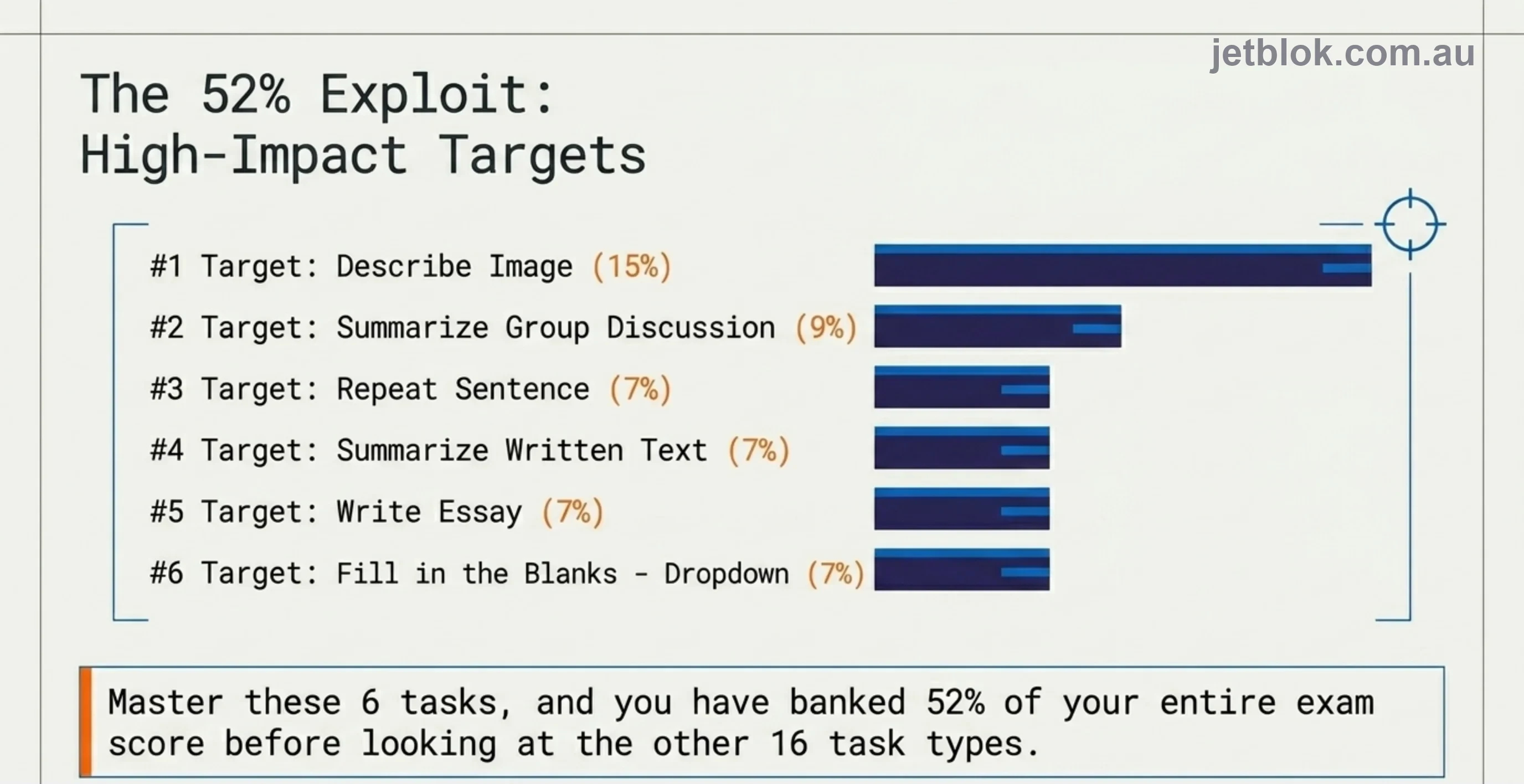
| Rank | Task | Overall Weight | Skill Contributions |
|---|---|---|---|
| 1 | Describe Image (DI) | 15% | 31% of Speaking |
| 2 | Summarize Group Discussion (SGD) | 9% | 20% of Listening, 19% of Speaking |
| 3 | Repeat Sentence (RS) | 7% | 17% of Listening, 16% of Speaking |
| 4 | Summarize Written Text (SWT) | 7% | 23% of Reading, 28% of Writing |
| 5 | Write Essay (WE) | 7% | 31% of Writing |
| 6 | FIB Dropdown (Reading) | 7% | 25% of Reading |
Notice that Describe Image alone is worth 15% of your overall score — more than double any other single task. If you only have 2 weeks to prepare, spend half of it on Describe Image. Also note the newcomer: Summarize Group Discussion at 9% is already the second-most impactful task in the entire exam.
The Hidden Giant: Write from Dictation
Write from Dictation doesn't appear in the top 6 by overall weight (it contributes about 5% to Overall), but look at its skill-level impact: it accounts for 23% of your entire Writing score and 13% of Listening. For anyone targeting a specific Writing threshold — especially for Australian visa purposes — WFD is non-negotiable. Read our dedicated Write from Dictation mastery guide for the phrase-mapping technique.
New Tasks Since August 2025
The two new question types are both high-impact and test skills that didn't exist in the old PTE format:
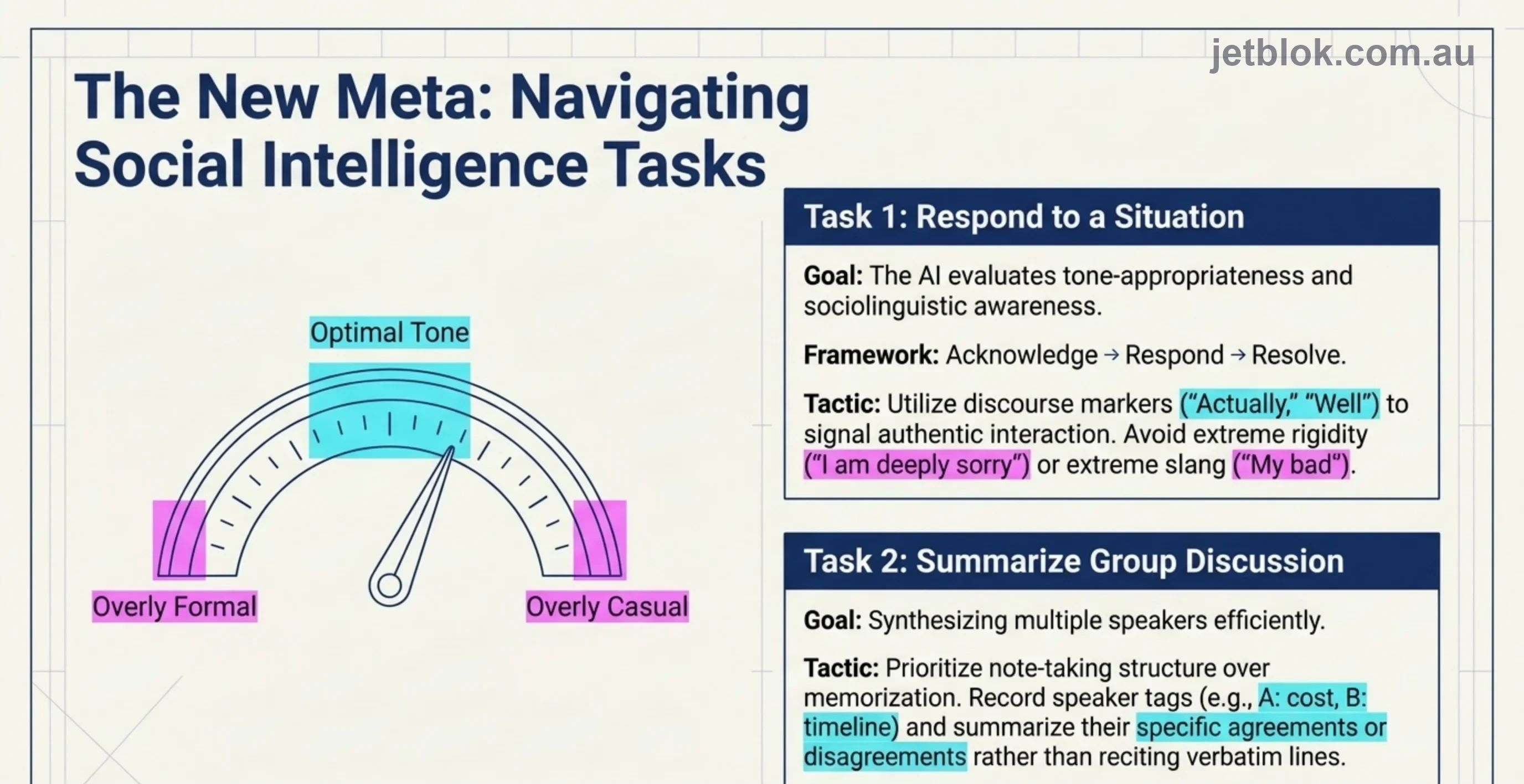
1. Summarize Group Discussion (SGD)
Format: Listen to a 3-way conversation lasting 2.5–3 minutes between three distinct speakers discussing an academic or social topic. You get 10 seconds to prepare, then 2 minutes to deliver your spoken summary.
What makes it different: Unlike Retell Lecture (which follows a single speaker), SGD requires you to track and attribute viewpoints to each individual speaker. Saying "the speakers discussed climate change" earns far fewer content marks than "Speaker A argued that renewable energy is the priority, while Speaker B emphasized the economic costs, and Speaker C suggested a phased approach."
Strategy:
- During the audio, note each speaker's position using shorthand (SA=..., SB=..., SC=...)
- Identify points of agreement and disagreement
- Structure your summary: topic → Speaker A's view → Speaker B's view → Speaker C's view → overall conclusion
- Use attribution phrases: "According to the first speaker...", "The second participant contended that...", "While the third speaker suggested..."
2. Respond to a Situation (RTS)
Format: You hear a university or workplace scenario (someone asking a favor, a conflict, a request for help). You get 10 seconds to prepare and 40 seconds to respond.
What it tests: Social intelligence and pragmatic language — your ability to navigate real-world English situations with appropriate tone, register, and content. This is the first PTE task that explicitly tests sociolinguistic competence.
Strategy:
- Acknowledge the situation empathetically before responding
- Provide a clear, reasonable position
- If declining a request, offer alternatives
- Match your register to the context (formal for professor, semi-formal for colleague, friendly for classmate)
- Fill the full 40 seconds — don't stop at 15 seconds with a one-line answer
PTE to IELTS Score Conversion (July 2025 Update)
Many applicants need to compare PTE and IELTS scores for university admissions or visa applications. The following conversion table reflects Pearson's July 2025 concordance update:
| IELTS Band | PTE Overall | PTE Speaking | PTE Writing |
|---|---|---|---|
| 6.0 | 47–54 | 54–65 | 51–59 |
| 6.5 | 55–62 | 66–75 | 60–68 |
| 7.0 | 63–70 | 76–82 | 69–76 |
| 7.5 | 71–78 | 83–87 | 77–84 |
| 8.0 | 79–85 | 88–89 | 85–89 |
| 8.5+ | 86–90 | 90 | 90 |
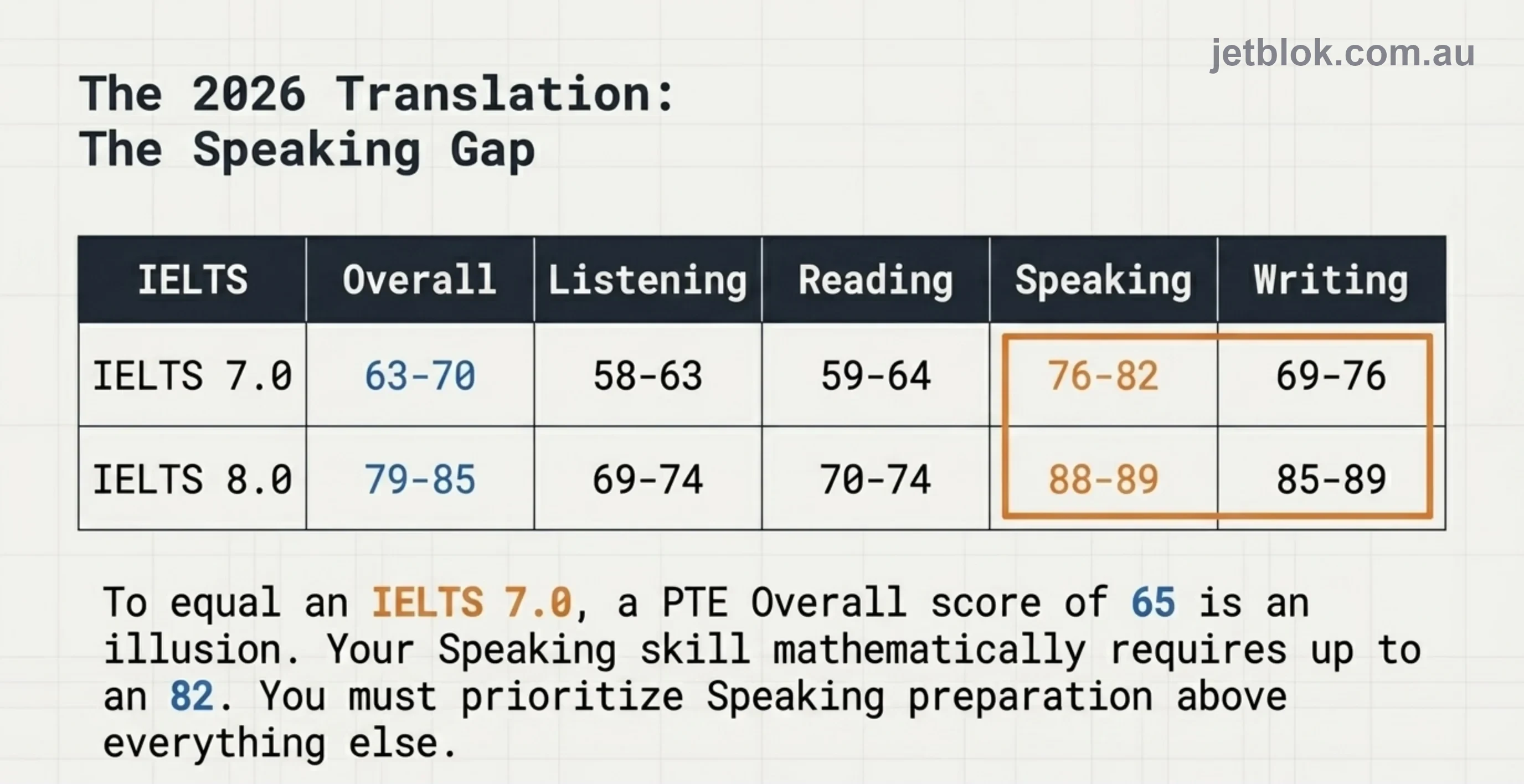
Critical Insight: To achieve the equivalent of IELTS 7.0, your PTE Speaking score needs to be 76–82 — that's 13+ points higher than the Overall requirement of 63–70. Speaking is disproportionately harder to score well in, and this catches many test-takers off guard. If you need IELTS 7.0 equivalent, you functionally need a PTE Speaking score in the high 70s, not the mid-60s.
Australian Visa Score Requirements (2026)
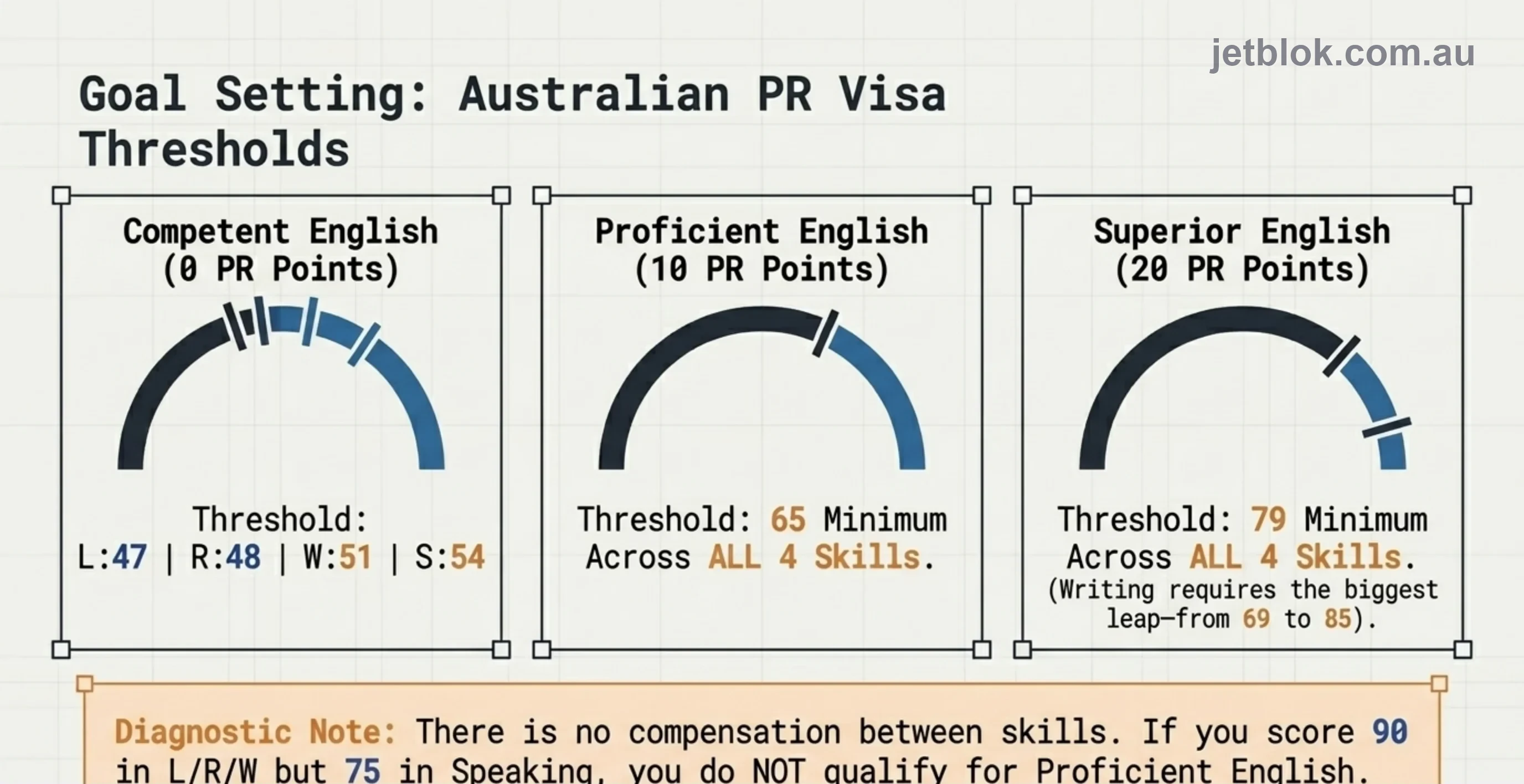
For Australian skilled migration visas (subclass 189, 190, 491, etc.), English ability is scored at three levels. All four skills must individually meet the minimum — you cannot average them out. Missing one skill by even a single point means you don't qualify for that level.
| English Level | Listening | Reading | Writing | Speaking | PR Points |
|---|---|---|---|---|---|
| Competent | 47 | 48 | 51 | 54 | 0 |
| Proficient | 58 | 59 | 69 | 76 | 10 points |
| Superior | 69 | 70 | 85 | 88 | 20 points |
Study these numbers carefully. The jump from Proficient to Superior is not uniform across skills:
- Listening: +11 points (58 → 69)
- Reading: +11 points (59 → 70)
- Writing: +16 points (69 → 85) — the biggest jump
- Speaking: +12 points (76 → 88)
Writing requires the largest improvement for Superior English. This is why Write from Dictation (23% of Writing), Summarize Written Text (28% of Writing), and Write Essay (31% of Writing) are absolutely critical if you're chasing 20 PR points. Focus your preparation accordingly.
How PTE's Integrated Scoring Works (Cross-Skill Contributions)
PTE's most counterintuitive feature is that tasks in one section contribute to scores in other skills. Here's why this matters practically:
- Repeat Sentence scores both Listening (17%) AND Speaking (16%) — mastering this single task boosts two skill scores simultaneously
- Write from Dictation contributes 23% to Writing and 13% to Listening — a task in the Listening section is your biggest lever for Writing
- Summarize Written Text contributes 23% to Reading and 28% to Writing — a task in the Speaking & Writing section feeds your Reading score
- Summarize Group Discussion contributes 20% to Listening and 19% to Speaking — the new task is a dual powerhouse
- FIB Drag & Drop (Reading) contributes to both Reading and Writing scores
The strategic implication is clear: there is no such thing as "just a Listening task" or "just a Writing task." Every task feeds into a web of interconnected scores. A weakness in Repeat Sentence doesn't just hurt your Listening — it simultaneously drags down your Speaking score.
Partial Credit and Negative Marking: Know the Rules
PTE uses partial credit scoring on 17 out of 22 task types, which means every correct element earns points even if your response isn't perfect. However, two tasks carry negative marking:
- MCQ Multiple Answers (Reading) — each incorrect selection deducts points. If you're guessing, you can end up with a negative score for that item.
- MCQ Multiple Answers (Listening) — same negative marking applies.
The practical rule: for multiple-answer MCQs, only select options you're confident about. Leaving a correct answer unselected costs you one point, but selecting a wrong answer costs you one point and erases a correct selection. Conservative play protects your score.
The #1 Rule: Flow Over Perfection
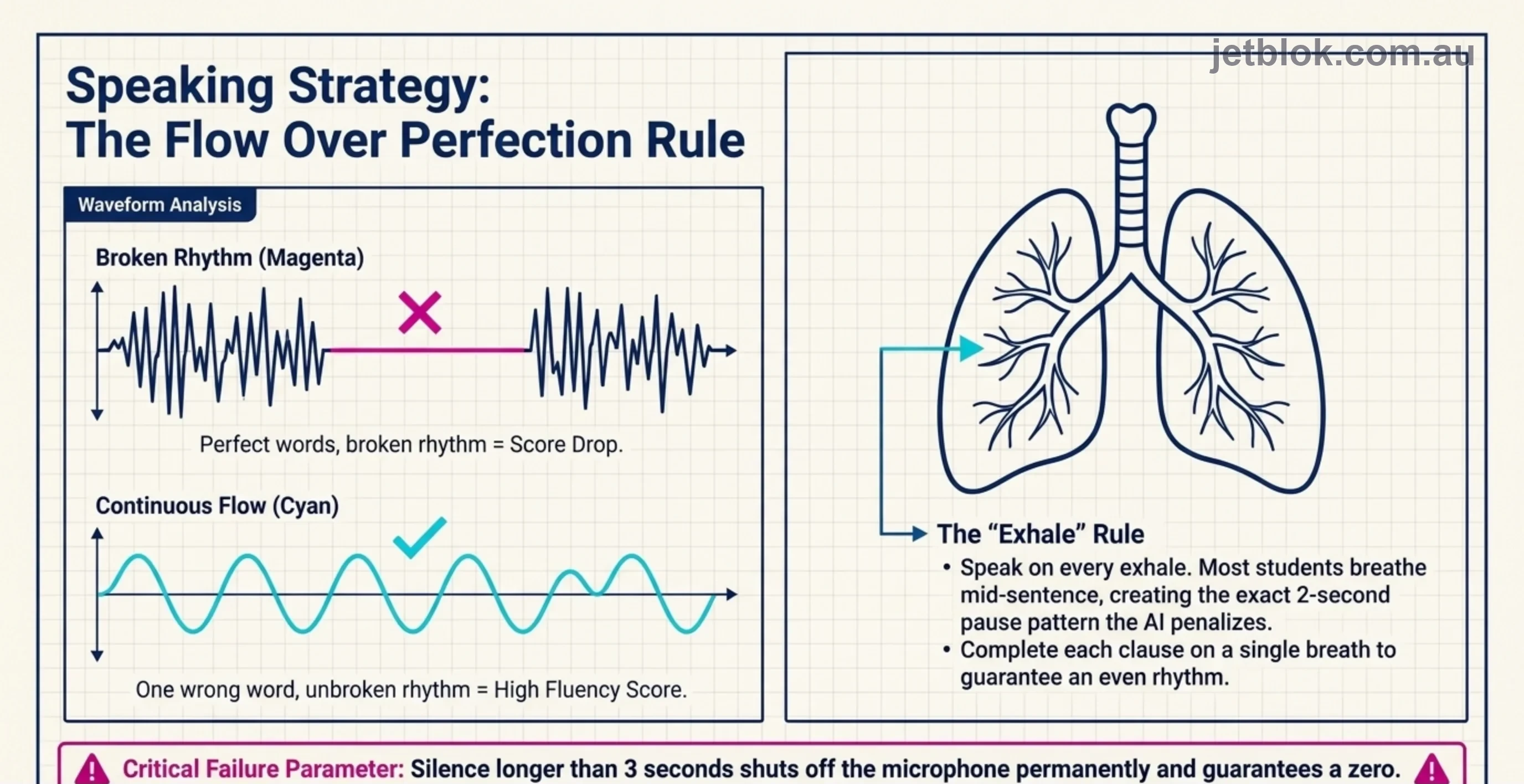
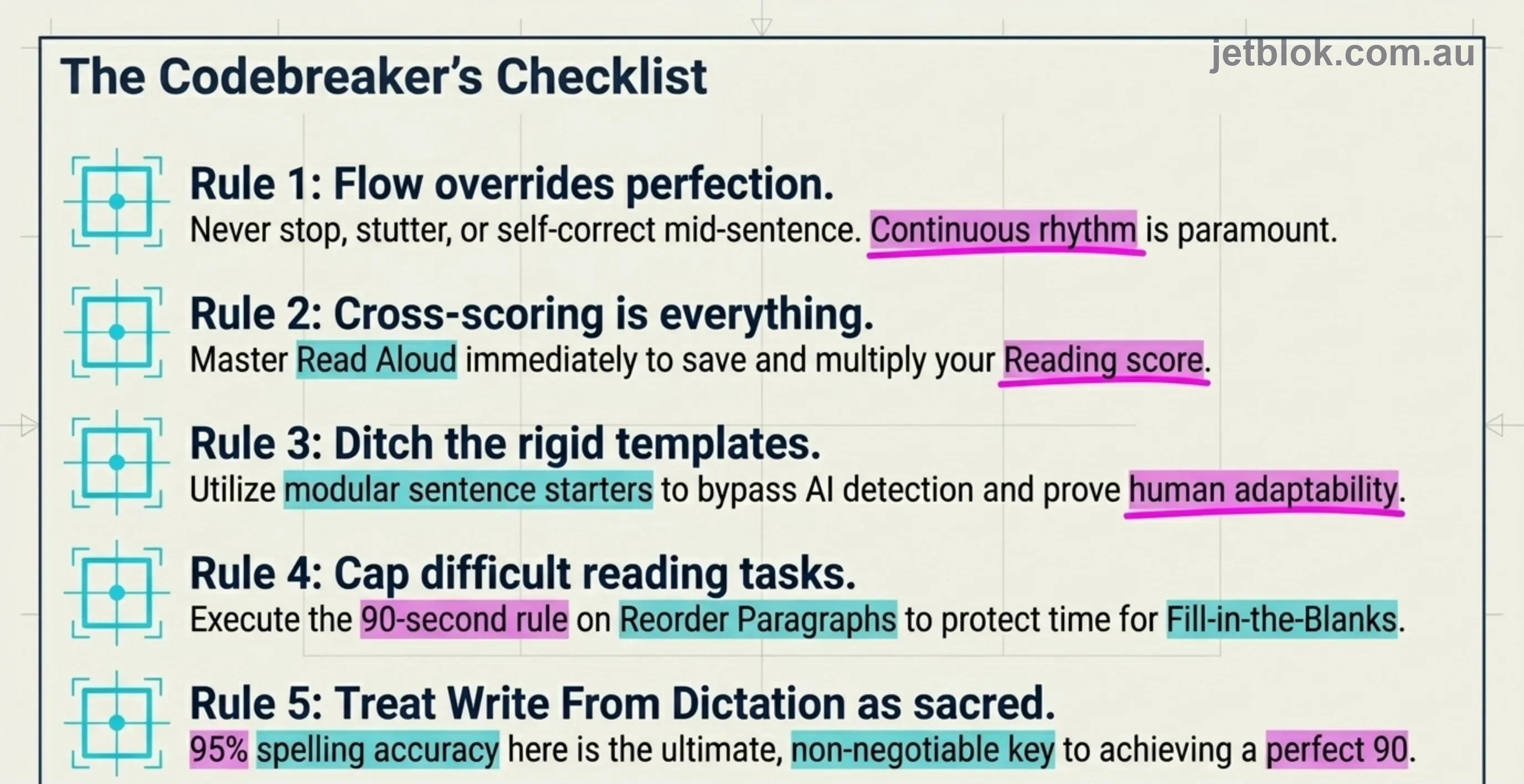
If you remember only one thing from this guide, let it be this: the 2026 AI prioritizes fluency over accuracy. A smooth, continuous delivery with minor errors will consistently outscore a choppy, self-correcting response that's technically more accurate.
The data supports this: analysis of high-scoring PTE responses shows that test-takers who scored 85+ in Speaking made an average of 2–3 minor grammar or pronunciation errors per response but maintained unbroken speech flow. Test-takers who scored 65–70 often had fewer errors but significantly more pauses, hesitations, and self-corrections.
The 3-Second Death Rule
In any Speaking task, 3 seconds of silence triggers automatic microphone deactivation. Once the mic cuts off, you receive a zero score for that entire task — not just for the remaining portion, but for everything. This is the single most devastating scoring rule in PTE and catches unprepared test-takers constantly.
Prevention strategies:
- Have filler phrases ready: "Additionally...", "Furthermore...", "It's also worth noting that..."
- If you lose your train of thought, repeat or paraphrase what you just said while you recover
- Practice speaking for the full allocated time in every practice session
- Never stop to think silently — think out loud, even if it means saying something obvious
Study Priority Framework Based on Official Weightings
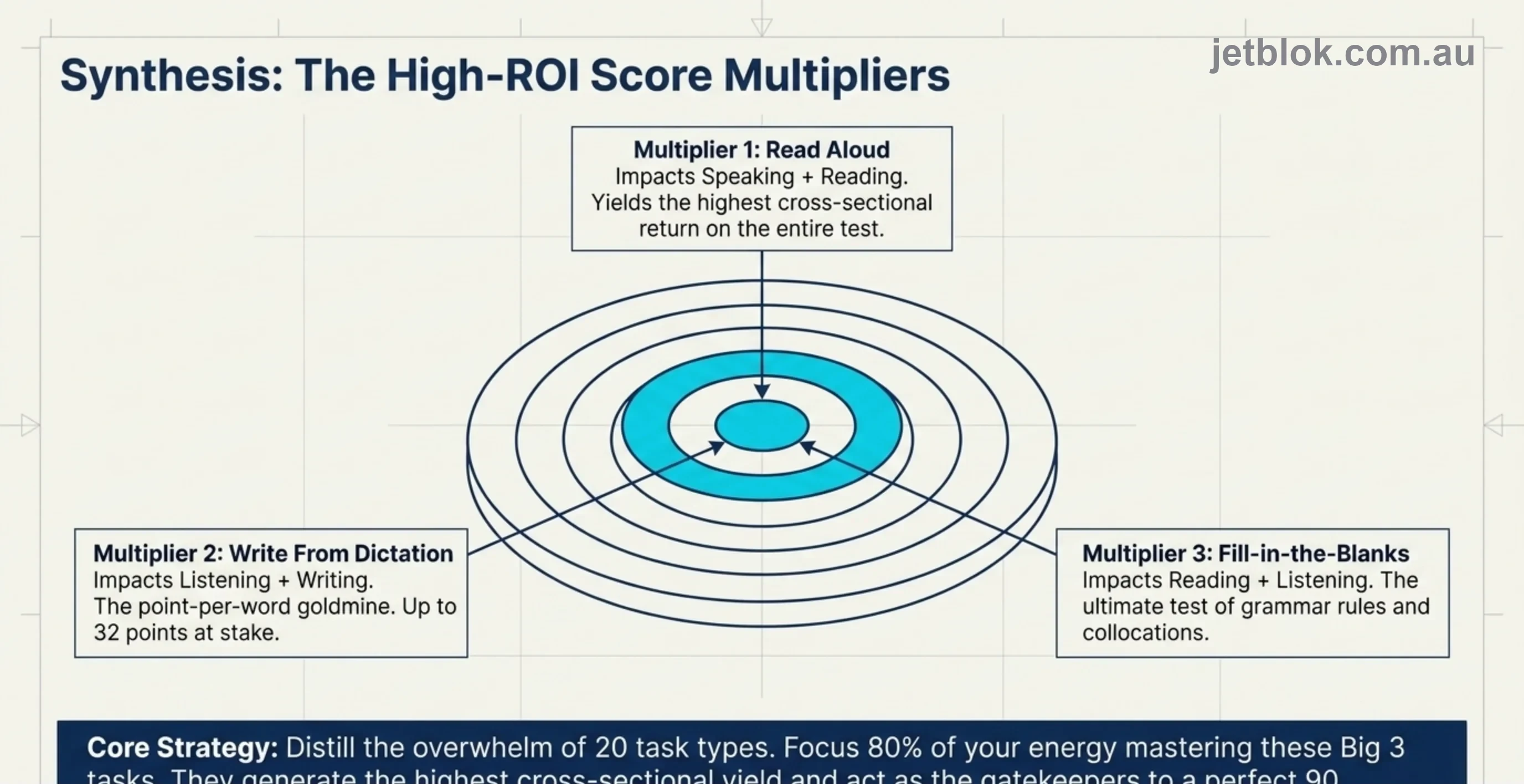
If you have limited preparation time, allocate it according to score impact. Here's the data-driven priority order:
Tier 1: Maximum Impact (Must Master)
- Describe Image (15% of Overall) — Your single biggest lever. Practice describing graphs, charts, maps, diagrams, and processes. Focus on trends and relationships, not individual data points. Use a flexible framework: type → main trend → highest/lowest → observation → conclusion.
- Summarize Group Discussion (9% of Overall) — The second-biggest task. Practice listening to panel discussions and attributing views to specific speakers.
Tier 2: High Impact (7% each, prioritize in this order)
- Repeat Sentence — Dual-skill booster (Listening + Speaking). Practice with progressively longer sentences. Use chunking: remember 3–4 meaning groups, not 12 individual words.
- Summarize Written Text — Dual-skill booster (Reading + Writing). Write one grammatically correct sentence of 35–55 words. Use conjunctions and relative clauses to combine ideas.
- Write Essay — 31% of your Writing score. Aim for 200–300 words. Use a flexible 4-paragraph structure but vary your language naturally.
- FIB Dropdown (Reading) — 25% of your Reading score. Build collocations knowledge: words that naturally go together (e.g., "conduct research", "pose a threat", "draw conclusions").
Tier 3: Strategic Impact
- Write from Dictation (5% of Overall but 23% of Writing) — Critical for anyone targeting a specific Writing threshold. Read our WFD strategy guide for the first-letter-capture technique.
- Read Aloud — Contributes to both Reading and Speaking. Practice meaning-chunk reading.
- Retell Lecture — Paraphrase, don't parrot. Human reviewers now specifically look for reformulation.
Tier 4: Protect Your Score
- MCQ Multiple Answers — Don't guess. Negative marking means wrong answers actively hurt you.
- Reorder Paragraphs — Don't spend more than 90 seconds per item. Find one logical pair and build from there.
- Highlight Incorrect Words — Only click words you're confident are wrong.
Task-by-Task Strategies for Scoring 90
Speaking Tasks
Read Aloud: Group words into meaning chunks of 3–5 words. Pause between chunks, not between words. Let your voice fall at periods and rise at commas. Never self-correct.
Repeat Sentence: Focus on capturing the beginning and end of the sentence (these are easiest to recall). If you miss a word in the middle, substitute a grammatically appropriate word and keep going. Copy the speaker's intonation pattern.
Describe Image: Spend the first 5 seconds identifying the image type and main trend. Use the remaining preparation time to note the highest/lowest points and one interesting observation. Speak for the full 40 seconds using this structure: introduction → main trend → specifics → conclusion.
Respond to a Situation: Acknowledge, position, elaborate, offer alternatives. Match your tone to the context. Fill the full 40 seconds.
Retell Lecture: Take keyword-only notes during the audio. Identify the main topic, 2–3 key supporting points, and the conclusion. Paraphrase everything — human reviewers penalize verbatim repetition.
Writing Tasks
Summarize Written Text: Write exactly ONE sentence. Aim for 35–55 words. Use "which", "while", "although", and "by" to connect ideas. Read the passage once for main idea, once for supporting details, then write.
Write Essay: Hit 200–300 words (under 120 or over 380 = automatic zero). Use a clear 4-paragraph structure: introduction with thesis → body paragraph 1 → body paragraph 2 → conclusion. Vary your vocabulary and sentence structures. Check spelling before submitting.
Reading Tasks
FIB Dropdown: Read the entire passage before selecting any answers. Look for collocations, grammar clues (articles, prepositions), and logical coherence. This task is 25% of your Reading score — take your time.
FIB Drag & Drop: Check that your selected word fits grammatically (part of speech) and semantically (meaning). Read the completed sentence aloud in your head to verify it sounds natural.
Reorder Paragraphs: Find the topic sentence (usually starts with a general statement, not a pronoun). Look for reference words ("this", "these", "such") that point back to a previous paragraph. Apply the 90-second rule — don't burn your time here.
Listening Tasks
Summarize Spoken Text: Aim for 55–65 words (the range is 50–70). Take notes on the main topic, key arguments, and conclusion. Write in past tense academic style.
Write from Dictation: Use the first-letter-capture method: jot down the first letter of each word as you hear it, then note 2–3 anchor words (unusual or long words). Reconstruct immediately after the audio ends. Every correctly spelled word in the right position = 1 point.
Highlight Incorrect Words: Follow along with the transcript while listening. Click only words you are certain don't match. This task has no partial credit — wrong clicks deduct points.
Common Mistakes That Kill Your Score
We've catalogued the most devastating PTE errors in our dedicated guide, but here are the critical ones:
- Template dependency — Pearson's AI now detects and penalizes rigid memorized templates
- Self-correction in Speaking — Creates pauses that destroy fluency scores
- 3-second silence — Instant zero for the entire task
- Word count violations — Under 120 or over 380 words in Essay = automatic zero; under 5 or over 75 in SWT = automatic zero
- Guessing on negative-marking MCQs — Wrong answers actively subtract from your score
- Poor microphone positioning — Breath distortion on plosive sounds (P, B, T) ruins pronunciation scores
Read the full breakdown: 10 Critical PTE Mistakes That Kill Your Score.
Microphone Setup: The Two-Finger Rule
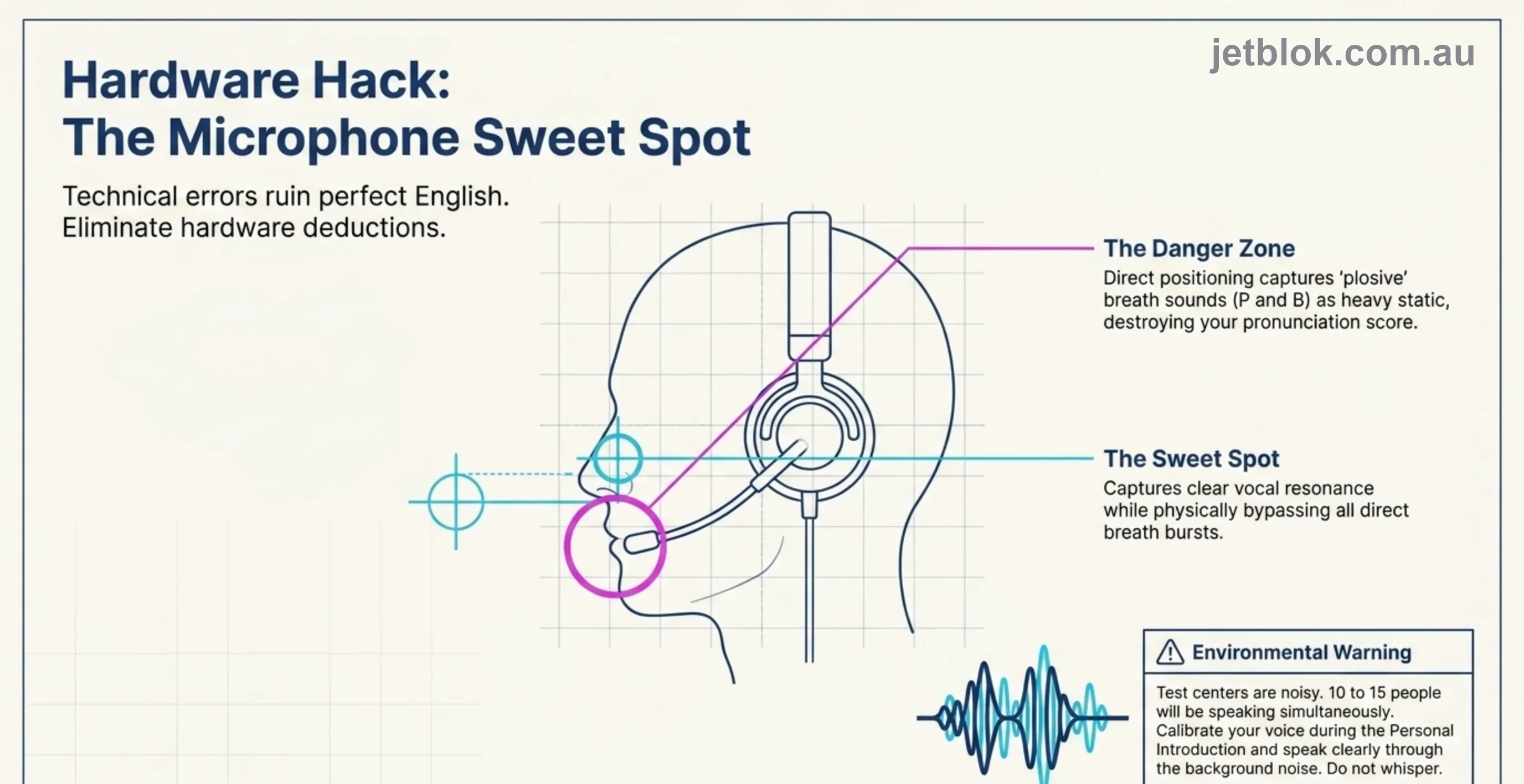
Technical setup directly affects your Speaking score:
- Position the microphone level with your nose, not in front of your mouth
- Keep it two fingers' width (about 3–4 cm) from your face
- This prevents breath distortion from plosive consonants (P, B, T, D)
- Always do the sound check at the beginning of the exam — don't skip it
Templates in 2026: What Still Works
Templates aren't dead — but rigid, word-for-word scripts are. What works in 2026:
- Flexible frameworks — Know the structure (intro → body → conclusion) but vary your vocabulary and sentence patterns each time
- Opening/closing phrases — Having 3–4 different ways to open a Describe Image or Essay response is fine
- Transition banks — Memorize 8–10 transition phrases and rotate through them naturally
What doesn't work:
- Copy-pasting the same 50-word introduction that 10,000 other test-takers used
- Reading your response in a flat, robotic monotone (the AI's "rhythmic monotony" detector flags this)
- Using the same template for every Describe Image regardless of image type
90-Day Study Plan for Scoring 90
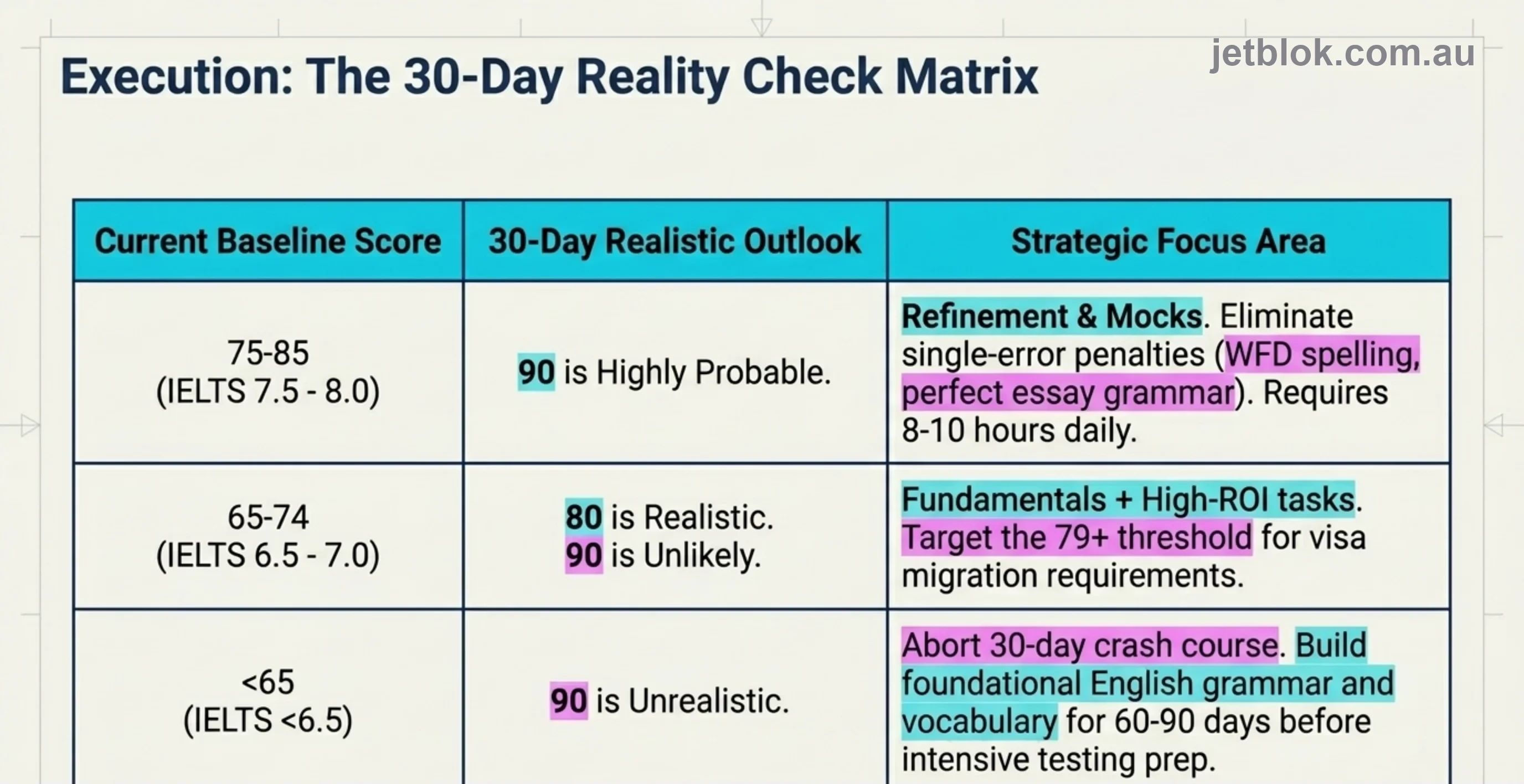
Weeks 1–2: Foundation & Diagnostics
- Take a full-length practice test to identify your weakest skills
- Study the scoring system and task weightings (this article)
- Set up daily practice routine: 1 hour Speaking, 30 minutes Reading, 30 minutes Listening
- Start WFD practice immediately (10 sentences/day)
Weeks 3–6: Targeted Skill Building
- Focus 40% of practice time on Describe Image (the highest-weight task)
- Practice Summarize Group Discussion with podcast panel discussions
- Work on Repeat Sentence with progressively longer sentences
- Write 2 practice essays per week with timed conditions
- Build collocations knowledge for FIB tasks
- Read our PTE Speaking Section guide for detailed task strategies
Weeks 7–10: Integration & Practice Tests
- Take a practice test every 5 days
- Review every scored response — identify patterns in your errors
- Practice under exam conditions: no pausing, strict time limits
- Focus on speed and fluency, not perfection
Weeks 11–12: Final Polishing
- Take 2 full practice tests per week
- Review common spelling traps
- Practice microphone setup and desk ergonomics
- Rest 2 days before the exam — cramming doesn't help with skill-based tests
Recommended Practice Platforms
- APEUni — Widely considered the best AI-calibrated practice platform. Its scoring algorithm closely mirrors Pearson's actual engine.
- PTE Tools — Excellent for Repeat Sentence and Write from Dictation drilling.
- E2Language — Structured courses with expert feedback, good for beginners.
- PTE Study (official Pearson) — Scored practice tests that use the actual scoring engine. Expensive but invaluable for final-stage preparation.
Test Day Checklist
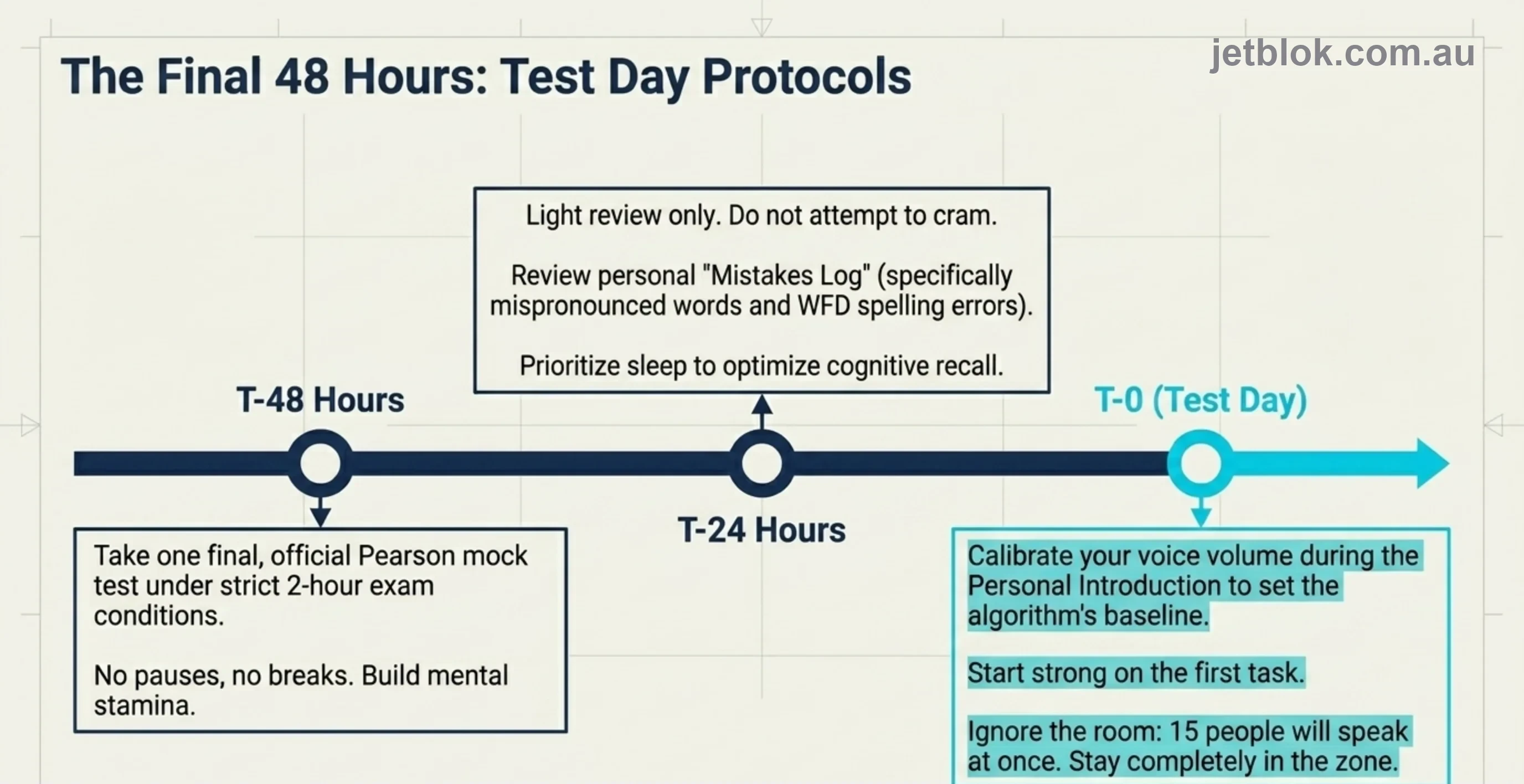
- Arrive 30 minutes early — late arrivals are turned away
- Bring valid, unexpired passport (the only accepted ID in most countries)
- Complete the microphone check carefully — position it at nose level
- During Speaking, keep sound flowing at all times — never go silent for more than 2 seconds
- In Reading, spend 60% of your time on FIB tasks and 40% on everything else
- In Listening, save your sharpest focus for Write from Dictation at the end
- Use American OR British spelling consistently throughout — both are accepted, but mixing them can trigger grammar penalties
Continue Your Preparation
This guide covers the strategic framework for scoring 90, but each section deserves deep-dive attention. Continue with our specialized guides:
- PTE Speaking Section 2026: Master All 7 Task Types — Detailed strategies for Read Aloud, Repeat Sentence, Describe Image, Respond to a Situation, and more
- PTE Write from Dictation: The #1 Task for Your Score — The phrase-mapping technique that turns WFD into free points
- 10 Critical PTE Mistakes That Kill Your Score — What NOT to do on exam day, from template dependency to word count traps
Your 90 is achievable. The test isn't measuring your intelligence or your accent — it's measuring your ability to communicate fluently, coherently, and accurately under timed conditions. Understand the scoring system, focus on high-weight tasks, keep your speech flowing, and trust your preparation. The data is on your side.