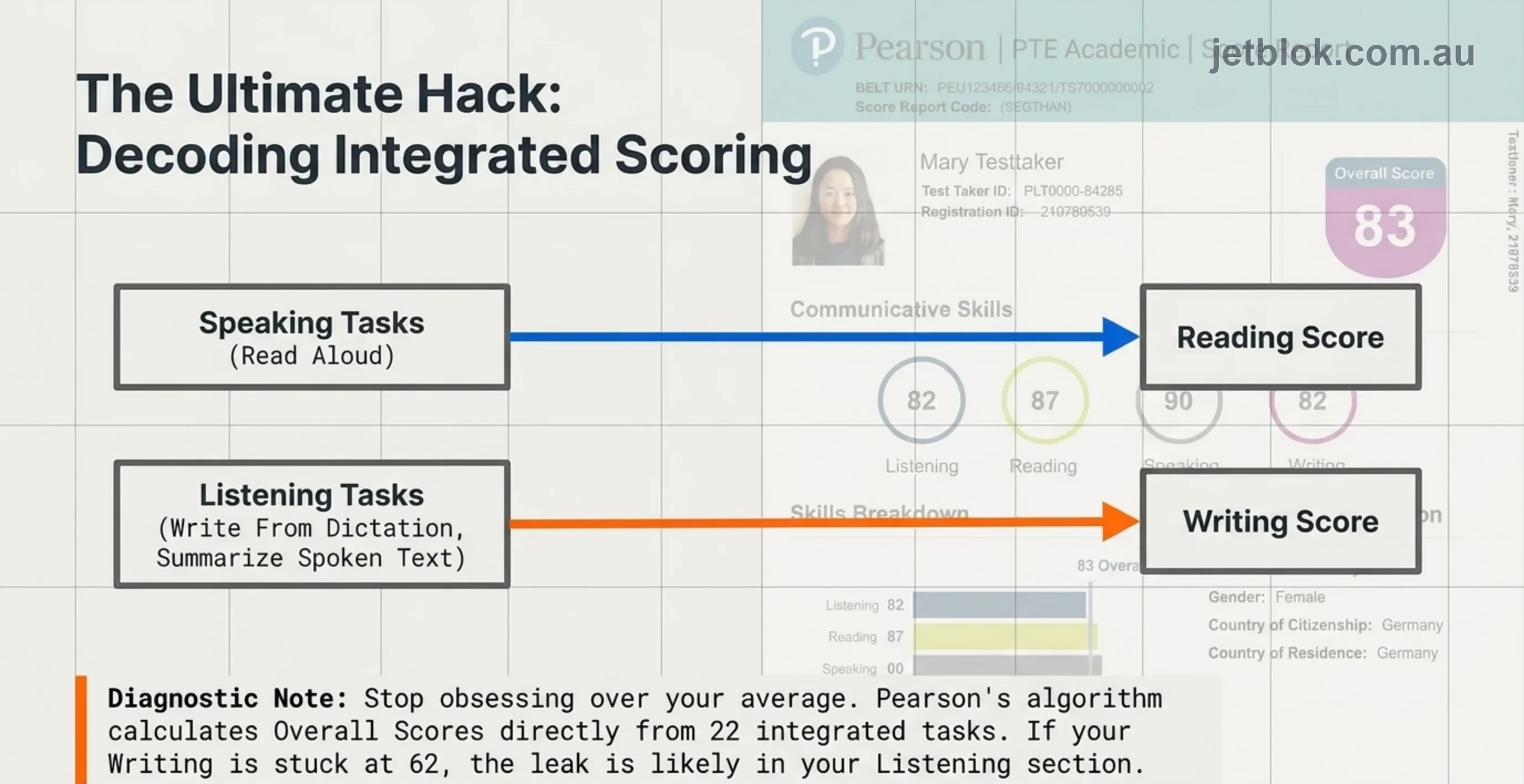
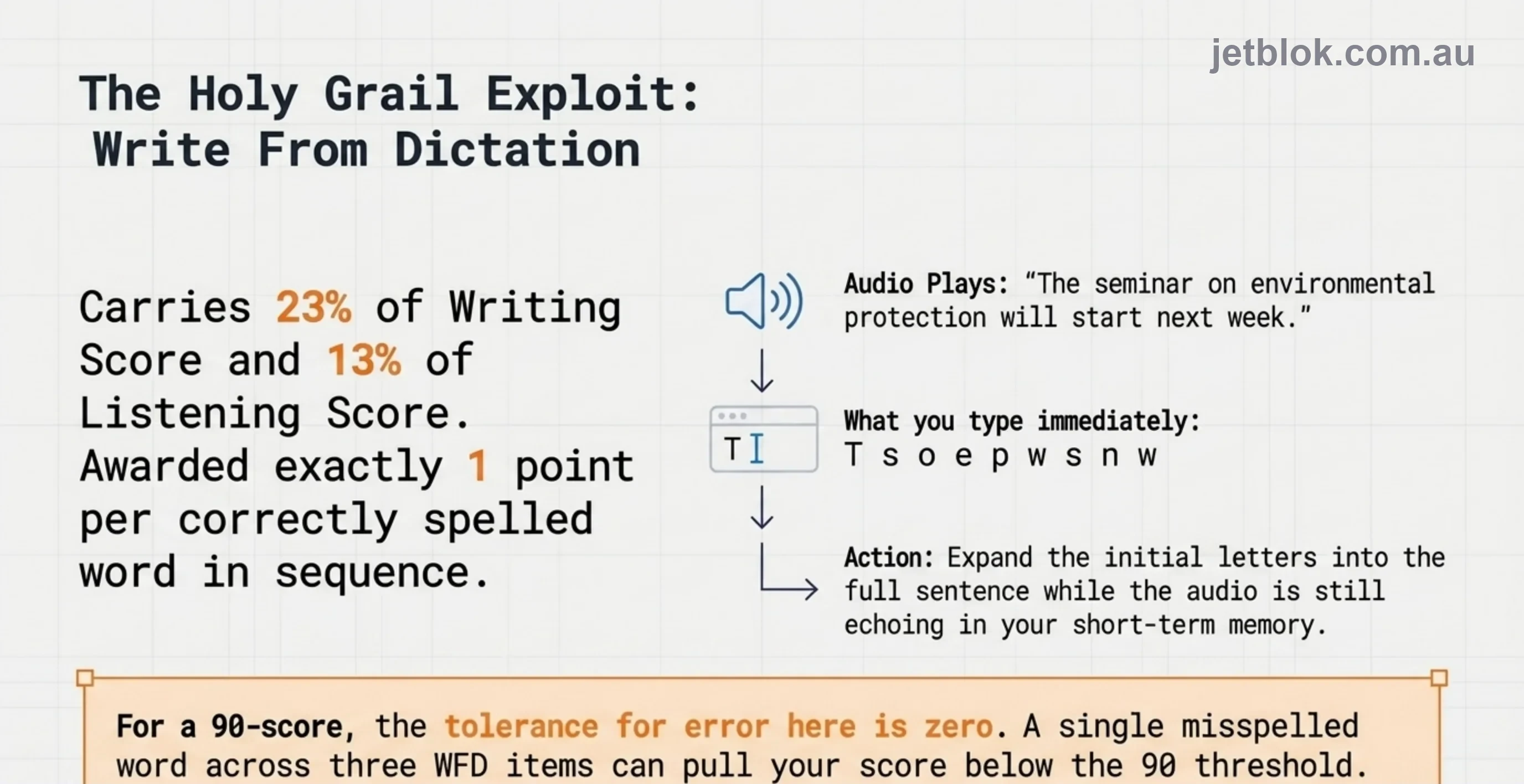
If there's ONE task you should master in PTE, it's Write from Dictation (WFD). This single task contributes 23% of your Writing score and 13% of your Listening score. Get this right, and you've secured a massive portion of your overall result.
Quick Summary (click to expand)
- WFD = 23% of Writing + 13% of Listening — the highest single-task impact
- Each correct word in the right position with correct spelling = 1 point
- Phrase Mapping: first-letter capture + anchor words + immediate reconstruction
- Common spelling traps: necessary, government, accommodation, definitely
- Recognize 4 academic grammar patterns to aid reconstruction
- Daily practice: 10-15 sentences minimum on APEUni or PTE Tools
- Golden rule: partial credit adds up — never give up on a sentence
Why WFD is So Important
Let's do the math:
- There are typically 3-4 WFD questions per test
- Each correctly spelled word in the right position = 1 point
- Average sentence = 10-12 words = 10-12 potential points
- Total potential: 35-50 points across the exam
No other single task type has this much impact on your final score.
How WFD is Scored
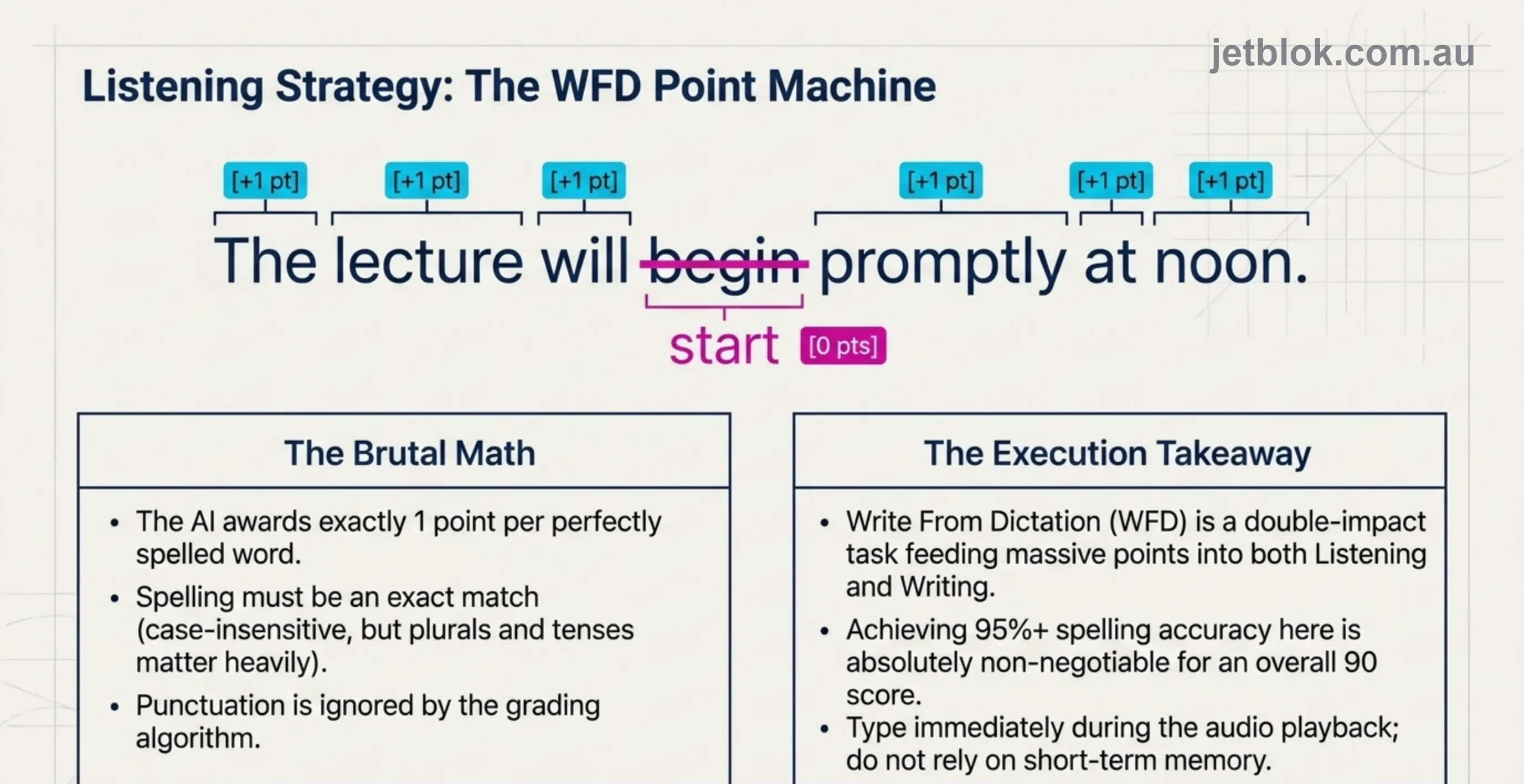
The scoring is beautifully simple - and brutally unforgiving:
- Correct word + correct position + correct spelling = 1 point
- Wrong spelling = 0 points for that word
- Missing word = 0 points
- Extra words don't add points but don't deduct either
The Phrase Mapping Technique
You can't memorize 12 words in real-time using brute force. Instead, use phrase mapping - a technique that leverages your short-term memory more effectively.
Step 1: First-Letter Capture
As you hear the sentence, quickly jot down the first letter of each word:
Sentence: "The library will be closed for renovations next month"
Notes: T l w b c f r n m
Step 2: Anchor Words
While writing first letters, also note 2-3 anchor words - longer or distinctive words that are easy to forget:
First letters: T l w b c f r n m
Anchors: library, renovations
Step 3: Immediate Reconstruction
Right after the audio ends, use your first letters + anchors to reconstruct:
- T = The
- l = library
- w = will
- b = be
- c = closed
- f = for
- r = renovations
- n = next
- m = month
Common Spelling Traps
These words are frequently misspelled in WFD:
| Word | Common Mistake | Correct Spelling |
|---|---|---|
| necessary | neccessary | necessary |
| government | goverment | government |
| environment | enviroment | environment |
| immediately | immediatly | immediately |
| occurred | occured | occurred |
| successful | succesful | successful |
| accommodation | accomodation | accommodation |
| beginning | begining | beginning |
| definitely | definately | definitely |
| professional | proffesional | professional |
Grammar Patterns to Recognize
WFD sentences follow predictable academic patterns. Recognizing these helps reconstruction:
Pattern 1: Subject + Verb + Object
"Students must submit their assignments before the deadline."
Pattern 2: There is/are + Noun
"There are several factors that contribute to climate change."
Pattern 3: It is + Adjective + to + Verb
"It is important to maintain a healthy work-life balance."
Pattern 4: The + Noun + of + Noun
"The purpose of this study is to examine student performance."
Practice Strategy
- Daily dictation practice: 10-15 sentences per day minimum
- Use APEUni or PTE Tools: These platforms have AI scoring similar to Pearson
- Review mistakes: Keep a list of words you commonly misspell
- Speed typing: Practice typing quickly - you have limited time to type after audio ends
- Listen to academic content: Podcasts, lectures, TED talks to train your ear
Test Day Tips
- Adjust volume before WFD tasks if possible
- Don't panic if you miss a word - write what you know
- Check spelling before moving on - you have a few seconds
- Use American or British spelling consistently - both are accepted but don't mix
The Golden Rule
Every word counts. A sentence with 8 out of 10 words correct is infinitely better than giving up because you missed 2 words. Partial credit adds up across all WFD questions.
Ready for more? Check our Complete PTE Listening Guide for strategies on all listening tasks.