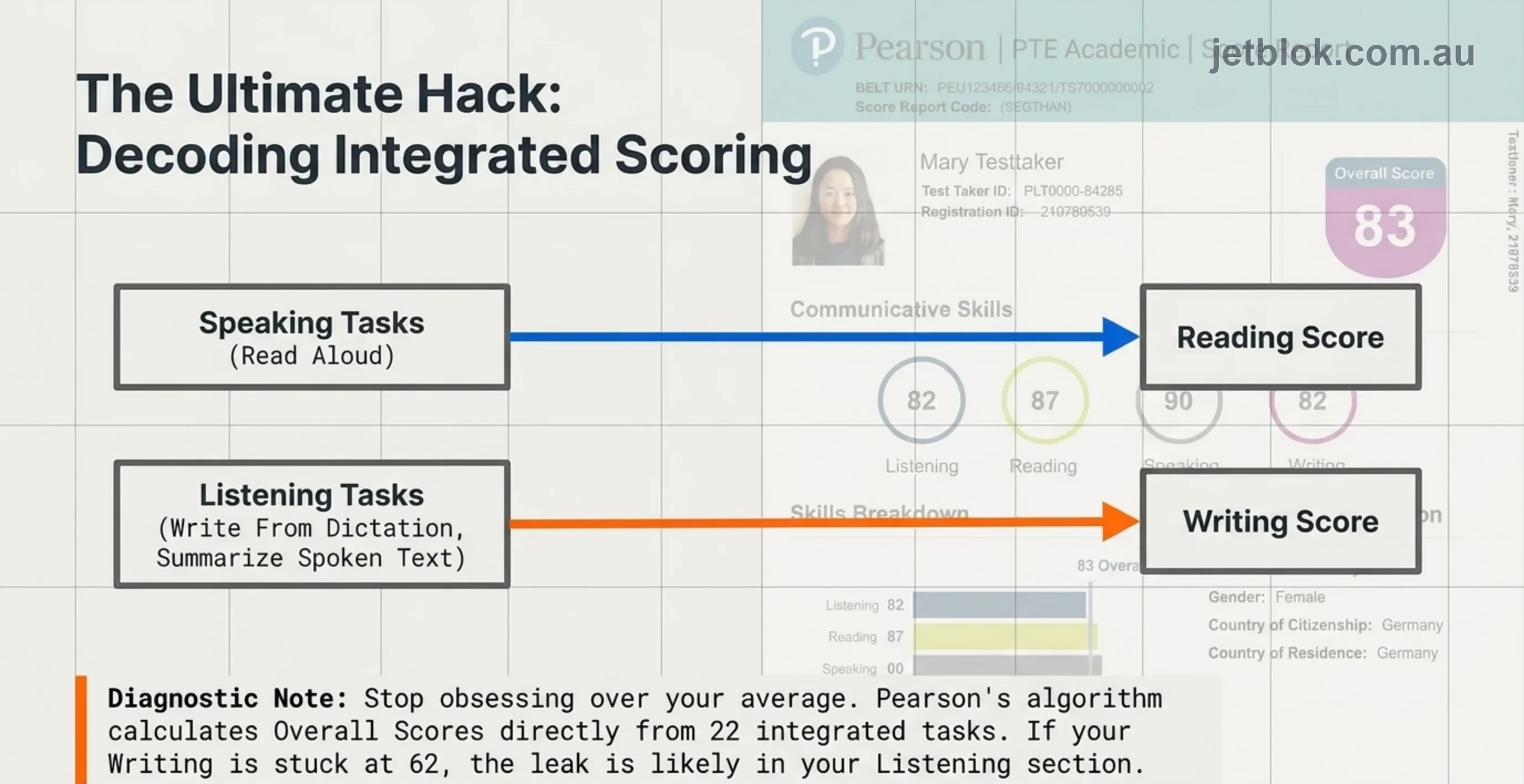
Here's something most PTE test-takers don't realize until it's too late: your Writing score isn't just built inside the Writing section. Tasks scattered across Speaking and Listening quietly feed points into your Writing total, and if you ignore them, you're leaving marks on the table before you even open a prompt. In this guide, we'll break down exactly where your Writing score comes from, then give you the strategies, frameworks, and practice routines to maximize every point.
Quick Summary (click to expand)
- 41% of your Writing score comes from Listening tasks (WFD + SST)
- SWT: one sentence, 35-55 words, contributes 28% to Writing + 23% to Reading
- Essay: target 270-290 words, 4-paragraph structure, accuracy over creativity
- Templates are being penalized in 2026 — use flexible frameworks instead
- Human reviewers now check Writing tasks alongside AI scoring
- Grammar accuracy is the single most controllable scoring factor
- Daily practice: 5 SWTs + 1 essay every other day + WFD drills
- Writing roadmap: WFD first, then Essay, then SWT, then SST
Where Your Writing Score Actually Comes From
PTE's integrated scoring system means four different task types contribute to your Writing score. Understanding this distribution is the first step to a high-scoring strategy.
| Task | Section | Writing Contribution | Overall Score Impact |
|---|---|---|---|
| Write Essay | Speaking & Writing | 31% | 7% |
| Summarize Written Text (SWT) | Speaking & Writing | 28% | 7% |
| Write from Dictation (WFD) | Listening | 23% | — |
| Summarize Spoken Text (SST) | Listening | 18% | — |
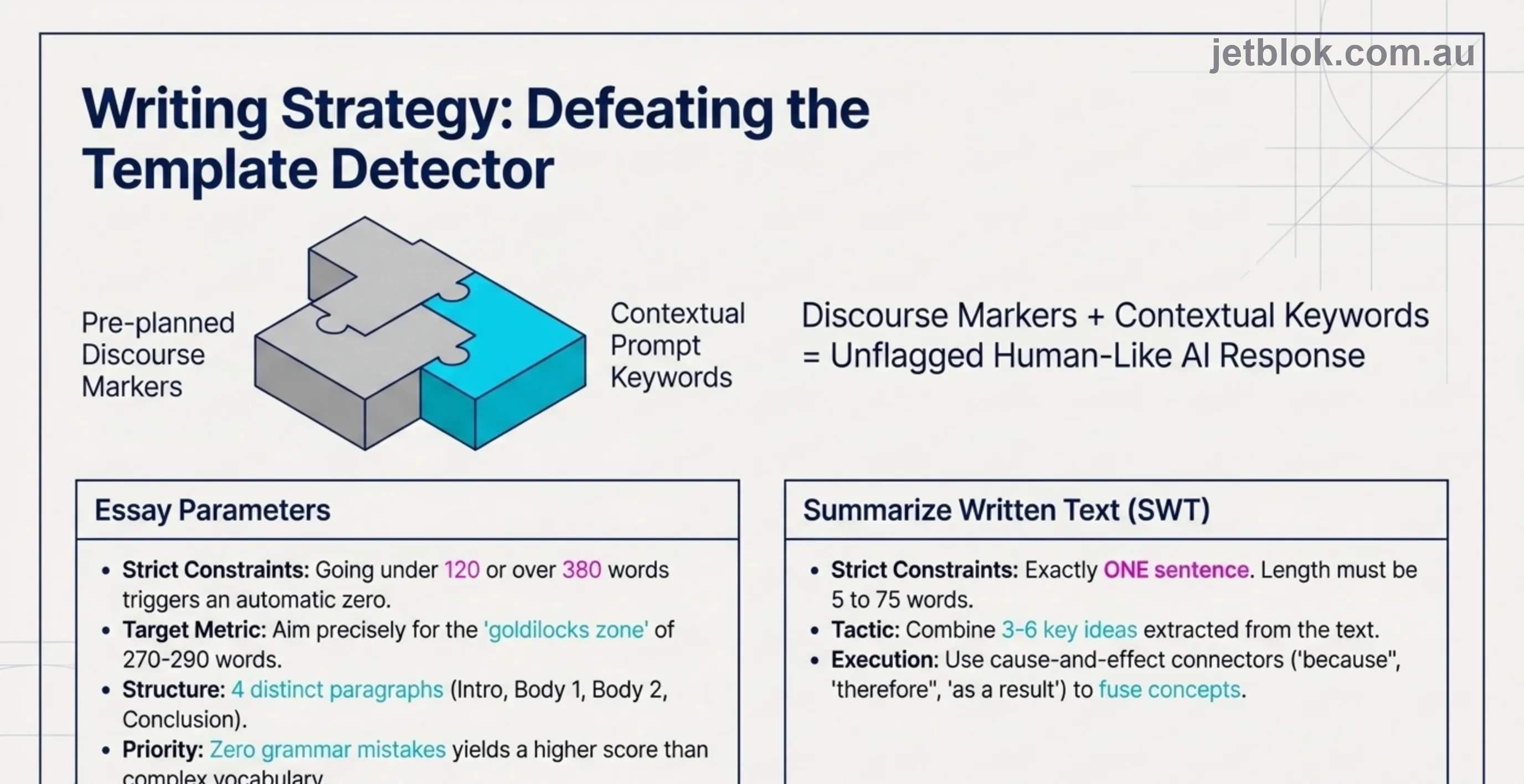
Look at that table carefully. Write from Dictation, a task that lives in the Listening section, delivers 23% of your Writing score. Summarize Spoken Text adds another 18%. That means 41% of your Writing mark is determined by tasks you encounter in Part 3 of the exam. If you want a deep dive on WFD specifically, read our Write from Dictation strategy guide.
The two tasks you directly control in the Writing portion — SWT and Essay — account for the remaining 59%. Together, they each contribute about 7% to your overall PTE score. That might sound modest, but in a test where 2-3 points can separate a 79 from an 82, these are points you can't afford to lose.
Summarize Written Text (SWT): One Sentence, Maximum Impact
Summarize Written Text is unique in the PTE because it feeds into two communicative scores simultaneously: 28% of Writing and 23% of Reading. No other writing task carries that dual impact, which makes SWT quietly one of the most valuable tasks in the entire exam.
The Rules You Cannot Break
- Your response must be one single sentence — no full stops in the middle, no splitting into two sentences
- Word count must fall between 5 and 75 words
- Going below 5 or above 75 words results in an automatic zero
- The sweet spot is 35 to 55 words — long enough to capture key ideas, short enough to maintain grammatical control
How SWT is Scored
Each SWT response is evaluated on five criteria:
- Content: Does your sentence capture the main ideas of the passage?
- Form: Is it a single sentence within the word limit?
- Grammar: Is the sentence grammatically correct?
- Vocabulary: Have you used appropriate academic vocabulary?
- Spelling: Are all words spelled correctly?
Here's the hierarchy that most test-takers get wrong: grammar accuracy matters more than vocabulary range. A grammatically perfect sentence with simple vocabulary will outscore a grammatically broken sentence with impressive words every time. The AI doesn't award bonus points for complexity — it penalizes errors.
The SWT Strategy: 4 Steps in 10 Minutes
Step 1: Identify the Core Ideas (3 minutes)
Read the passage once. On a second pass, underline or mentally flag 3 to 6 key ideas. Look for:
- The main topic or thesis
- Supporting arguments or evidence
- Any conclusions or implications the author draws
Step 2: Build a Logical Skeleton (2 minutes)
Arrange your key ideas into a cause-effect or argument chain. Use connecting language like:
- "because", "therefore", "as a result"
- "which leads to", "consequently", "while also"
- "although", "despite", "in addition to"
These cause-effect words are your best friends in SWT. They let you combine multiple ideas into one grammatically sound sentence without the sentence feeling forced.
Step 3: Write and Rephrase (3 minutes)
Write your single sentence. Critically, do not copy the passage verbatim. Aim to rephrase 40-50% of the language. The AI and human reviewers both check for paraphrasing, and lifting entire phrases word-for-word will hurt your Content and Vocabulary scores.
Also resist the temptation to always open with "The passage discusses..." or "The author explains that..." These openers are so overused that they signal a formulaic response. Instead, lead with the actual subject matter.
Weak opening: "The passage discusses how climate change affects agriculture."
Stronger opening: "Climate change significantly disrupts agricultural productivity by..."
Step 4: Check Form and Grammar (2 minutes)
Before submitting, verify three things:
- Is it genuinely one sentence? (Only one period, at the very end)
- Is the word count between 35 and 55?
- Does every verb agree with its subject?
SWT Flexible Framework
This is a framework, not a memorized template. Adjust the vocabulary and structure for each passage:
"The passage explains [main idea], while also highlighting [supporting detail], indicating that [conclusion or implication]."
Vary it. Sometimes lead with the conclusion. Sometimes start with a concession. The goal is having a structural safety net, not a script that the AI can detect.
SWT Common Traps
- Writing two sentences: Any period in the middle (even an accidental one) = Form score of zero
- Trying to include everything: You're summarizing, not transcribing — select the most important ideas
- Exceeding 75 words: When you use multiple clauses, word count creeps up fast — count before submitting
- Using vocabulary you're unsure of: A misspelled "sophisticated" word hurts more than a correctly spelled simple one
Write Essay: 270 Words That Matter
The Write Essay task contributes 31% of your Writing score and 7% of your overall PTE score. You'll receive a prompt — typically an opinion-based or discussion topic — and have 20 minutes to write a response.
The Word Count Rules
- Acceptable range: 200 to 300 words
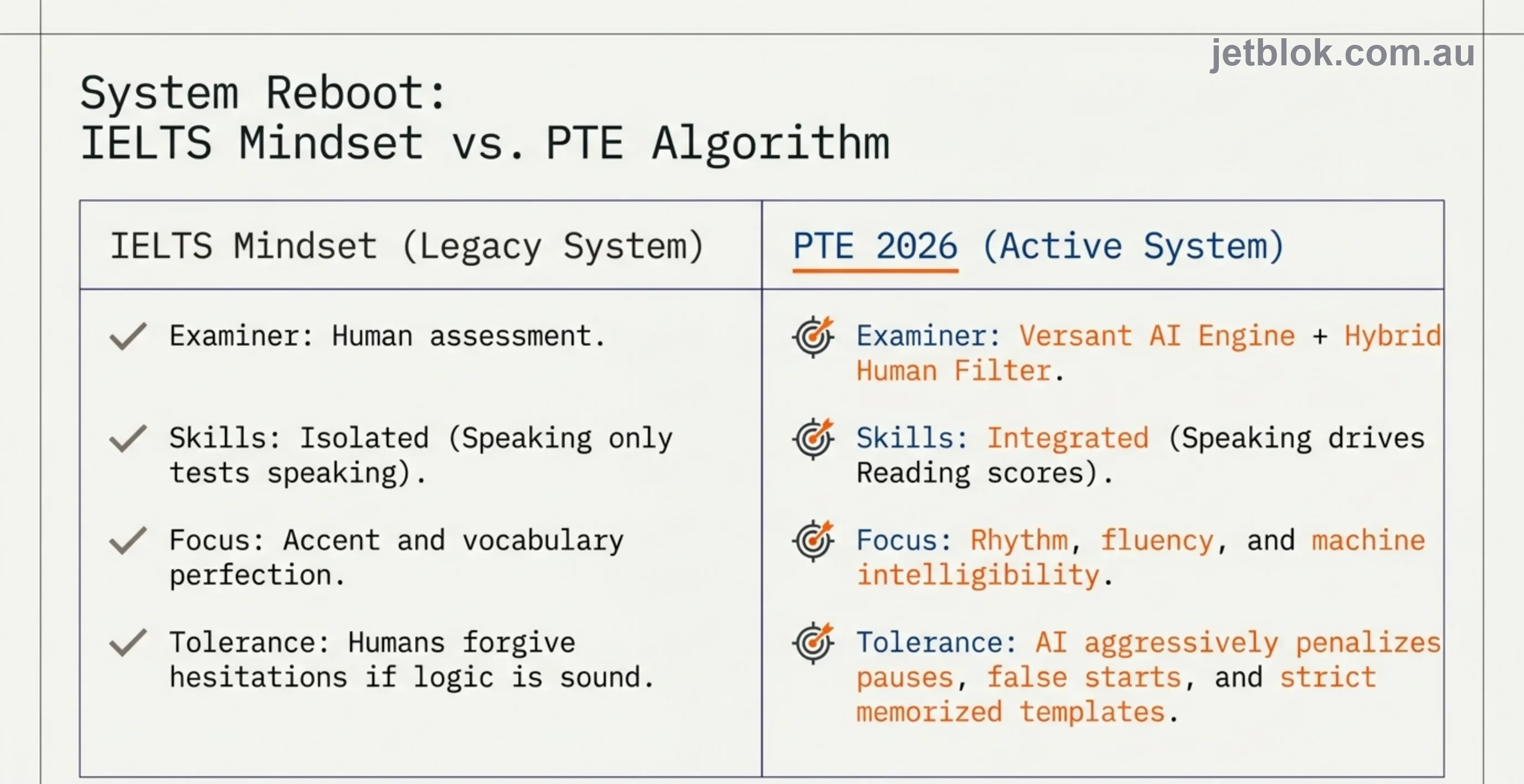
- Below 120 words or above 380 words = automatic zero
- The sweet spot is 270 to 290 words
Why 270-290? Because it gives you enough space to develop two body paragraphs with examples, while keeping you safely away from both penalty thresholds. Writing 250 words is fine, but you're cutting it close on content depth. Writing 310 is fine too, but every extra word is another chance for a grammar error with no additional content reward.
Essay Structure That Scores
The highest-scoring essays follow a clean, predictable structure. Pearson's AI rewards logical organization:
Paragraph 1 — Introduction (2 sentences)
- Sentence 1: Contextualize the topic
- Sentence 2: State your position or thesis
Paragraph 2 — Body 1 (3-4 sentences)
- Present your main argument
- Support with a specific example
- Explain the result or implication
Paragraph 3 — Body 2 (3-4 sentences)
- Present a counter-argument or second perspective
- Support with a different example
- Connect back to your thesis
Paragraph 4 — Conclusion (1 sentence)
- Summarize your position in one clean sentence
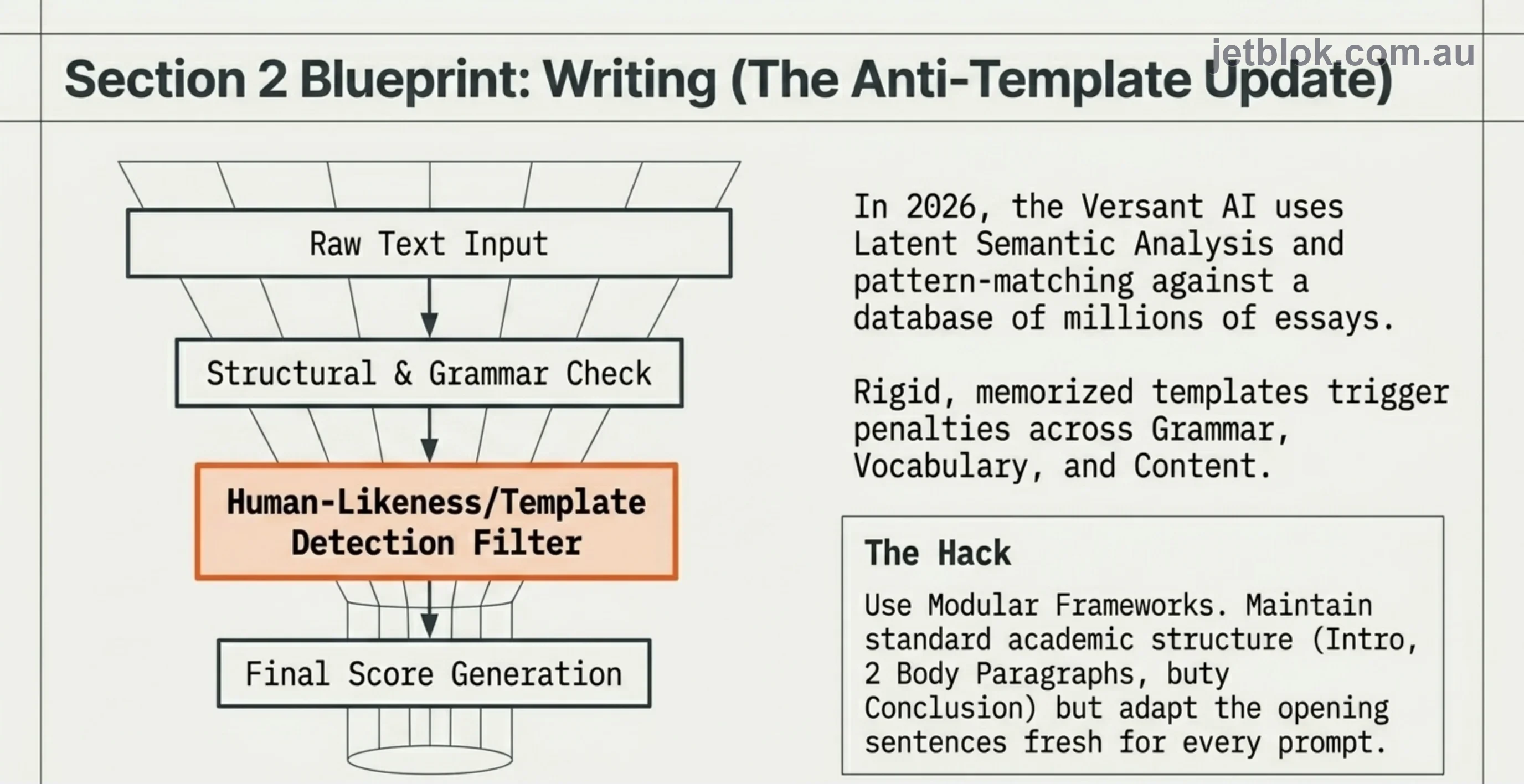
Template Safety: Why Rigid Scripts Fail in 2026
This is the single biggest change in 2026 PTE scoring. Pearson's algorithms now actively detect template-dependent responses. The AI looks for what Pearson calls "rhythmic monotony" — identical sentence structures, opening phrases, and paragraph patterns that appear across thousands of test-takers.
If the AI flags your essay as template-dependent, your Content and Form scores drop significantly. Human reviewers, who now check Writing tasks alongside AI scoring, will also penalize essays that feel rehearsed rather than responsive to the specific prompt.
Template Safety Rules
- Never memorize word-for-word. Learn the structure, not the sentences.
- Change sentence structures each time. If your intro was a simple statement last time, try a concession this time.
- Adjust vocabulary naturally. Don't force the same "sophisticated" words into every essay.
- Match topic context. An essay about technology should sound different from one about education.
- Create your own template so nobody else has the same one.
A Flexible Essay Framework
Use this as a starting point, then make it yours:
Introduction:
"In recent times, the issue of [topic] has attracted significant attention. In my opinion, this development has both advantages and challenges."
Body paragraph opening:
"One major reason is [argument]. This can be seen when [example]. As a result, [implication]."
Conclusion:
"In conclusion, while [topic] presents some concerns, its benefits can outweigh the drawbacks if managed effectively."
Now here's the important part: don't use this framework exactly as written. Swap "In recent times" for "Over the past decade" or "Across many countries." Replace "In my opinion" with "From my perspective" or simply state your view directly. The framework gives you bones — you add the muscle.
Accuracy Over Creativity
This is counterintuitive for many test-takers: simpler essays with clean grammar score higher than complex essays with errors. The AI rewards accuracy, not ambition. Consider this comparison:
Complex but flawed: "The multifaceted ramifications of technological ubiquity has permeated every facets of contemporary society."
Simple but correct: "Technology has significantly changed many aspects of modern life."
The second sentence scores higher. It has correct subject-verb agreement, proper article usage, and clear meaning. The first has two grammar errors ("has" instead of "have," "facets" instead of "facet") that the AI catches instantly.
Essay Mistakes That Cost Points
- Memorized opening lines: "This essay will discuss" is a red flag for template detection
- Repeating the same connectors: Using "Furthermore" at the start of every body sentence signals rigidity
- Writing below 200 words: You're likely missing a body paragraph or sufficient examples
- Grammar errors in long sentences: If you can't control a 25-word sentence, split it into two shorter ones
- Off-topic examples: If the prompt asks about education, don't spend a paragraph on unrelated economics
- Exceeding 300 words: More words means more chances for errors with diminishing content returns
Human Review: What Changed in 2026
Both SWT and Essay now receive human review alongside AI scoring. This is a significant shift from previous years. Here's what human reviewers check:
- Content relevance: Did you actually answer the prompt, or did you write a pre-prepared response that vaguely relates to the topic?
- Originality: Does your response show genuine engagement with the passage or question?
- Coherence and logical flow: Do your ideas connect logically, or are they a jumble of memorized phrases?
Human reviewers use the same rating scales as the AI, so there's no conflict between the two scoring systems. But the addition of human eyes means that purely template-driven responses — the kind that might have fooled the 2024 AI — now get caught. Your writing needs to demonstrate that you read the prompt and responded to it, not to a generic topic in the same category.
Grammar: The Non-Negotiable Foundation
Grammar accuracy is the single most controllable factor in your Writing score. Unlike content knowledge or vocabulary breadth, grammar follows clear rules you can practice systematically. Focus on these five areas:
1. Subject-Verb Agreement
The most common error in PTE Writing. When your subject and verb are separated by a long phrase, it's easy to lose track:
Wrong: "The impact of rising temperatures on coastal regions are significant."
Right: "The impact of rising temperatures on coastal regions is significant."
The subject is "impact" (singular), not "regions." Train yourself to find the true subject.
2. Article Usage (a, an, the)
Articles are invisible to native speakers but a minefield for many test-takers. The rules are complex, but in PTE Writing, the most common mistake is dropping articles entirely: "Government should invest in education" instead of "The government should invest in education."
3. Prepositions
Incorrect prepositions won't always destroy meaning, but the AI catches them: "depend on" not "depend of," "result in" not "result to," "contribute to" not "contribute for."
4. Sentence Punctuation
In SWT especially, punctuation determines whether your response is one sentence or two. A misplaced period is catastrophic. Use commas, semicolons, and conjunctions to join clauses — never periods within your single-sentence response.
5. Verb Tense Consistency
Pick a tense and stick with it within each paragraph. Shifting from past to present to future within three sentences confuses the AI's coherence scoring and makes your writing feel disjointed.
Practice Routine That Actually Works
Writing without feedback doesn't improve your score. You need a structured practice routine with measurable progress.
Daily SWT Practice
- Complete 5 SWT questions per day
- Use platforms with AI scoring (APEUni, PTE Tools) so you get instant feedback
- After each response, check: word count, sentence count (must be 1), and grammar accuracy
- Keep a log of recurring errors and target those specifically
Essay Practice
- Write 1 full essay every alternate day
- Time yourself strictly at 20 minutes
- After writing, go back and identify every grammar error before checking AI feedback
- Practice hitting 270-290 words until word estimation becomes instinctive
Integration with Other Tasks
Since 41% of your Writing score comes from Listening tasks, your practice routine should include:
- Daily Write from Dictation practice (10-15 sentences)
- Summarize Spoken Text practice (2-3 per session)
- Spelling drills for commonly misspelled academic words
Tying It All Together: The Writing Score Roadmap
If you're aiming for a Writing score of 79 or above, here's where to focus your energy, ranked by impact:
- Write from Dictation (23% of Writing): Perfect your phrase mapping technique. Every correctly spelled word counts. This is the highest-return task for Writing score improvement.
- Write Essay (31% of Writing): Master the 4-paragraph structure, hit 270-290 words, and prioritize grammar accuracy over vocabulary complexity.
- Summarize Written Text (28% of Writing): Nail the single-sentence format at 35-55 words. Remember this also boosts your Reading score by 23%.
- Summarize Spoken Text (18% of Writing): Stay within the 50-70 word limit and capture main ideas with accurate grammar.
Notice the pattern: accuracy beats complexity at every level. Correct spelling in WFD, correct grammar in Essay and SWT, correct word count in every task. The test-takers who score 85+ aren't the ones with the fanciest vocabulary — they're the ones who make the fewest mistakes.
Quick Reference: Writing Task Cheat Sheet
| Task | Word Count | Zero Threshold | Target | Key Focus |
|---|---|---|---|---|
| SWT | 5–75 | <5 or >75 | 35–55 words | One sentence, grammar accuracy |
| Essay | 200–300 | <120 or >380 | 270–290 words | Structure, accuracy, flow |
| WFD | Exact dictation | — | Every word | Spelling, word order |
| SST | 50–70 | <50 or >70 | 55–65 words | Main ideas, grammar |
Final Advice
The PTE Writing section rewards discipline, not brilliance. You don't need to be a gifted writer. You need to follow the rules: hit the word counts, maintain grammatical accuracy, respond to the actual prompt, and use flexible frameworks instead of rigid templates. The test-takers who treat Writing as a systematic process — rather than an opportunity to impress — are the ones who consistently score above 79.
For a complete overview of the PTE exam structure, scoring system, and all 22 task types, read our PTE Academic 2026 Complete Guide. And if you haven't already, make sure you've locked down your Write from Dictation strategy — it's the single highest-impact task for your Writing score.